Monday, July 26, 2010

[22] "Children of the Living God" [Pentecost +9]

This is the text I preached off of. It was a draft, and I was tired, so what I actually preached had a lot more editorializing and extemporizing.

When I copied it from GoogleDocs into Word to print out for preaching, it erased the indenting I had put in to indicate notes I probably wouldn't use, so I ended up including some stuff I hadn't initially meant to. I've put those sections in small font and also edited them a bit to better reflect what I actually said (though for the most part I've left the text as-is, not editing it to be a verbatim of what I said aloud).

The Scripture texts (a mix of The Inclusive Bible and the NRSV) are at the bottom.

***

Proper 12C / Ordinary 17C / Pentecost +9 - July 25, 2010
Hosea 1:2-10
Psalm 85
Colossians 2:6-19
Luke 11:1-13
Children of the Living God

I did not realize, when I agreed to preach this Sunday, that the lectionary would be in Hosea at this point. I am stubborn in my desire to preach on all 4 lectionary texts, though. And I appreciate the way this passage ends:
"Yet the people of Israel will be as numerous as the sands of the seashore that can neither be measured nor counted. And one day, instead of it being said of them, 'You are not my people,' it will be said, 'You are the children of the living God.'"
Even in the stories of judgment, there is a promise of redemption.

This promise of redemption and provision is the theme of all of today's Scripture lessons.

The Psalm opens with a recollection of God's gracious favor -- and I don't mean "gracious" in the condescending sense of patronizing politeness; I mean full of grace. "The freely given, unmerited favor and love of God." God, you were favorable to your land and to your people, restoring their fortunes, forgiving their iniquity and pardoning their sin, withdrawing your wrath.

So where is that grace now?, the Psalmist begs. "Will you be angry with us forever? Will you prolong your anger to all generations?" How long, O God, how long?

God, your love for us is steadfast. Grant us, we beg, salvation.

And Paul reminds us that we HAVE salvation.

The law that bound us, all of our sins and transgressions, these have been crucified. And unlike Christ, they are NOT resurrected. Their power over us is dead.

We share in the hope of the Psalmist. For Jesus promises us, just as you would provide food for your child, or a friend who stopped by unexpectedly, or a neighbor who is banging on your door, so much more will the Mother-Father who loves us beyond comprehension give us good gifts to nurture and sustain us.

The Lukan version of the "Our Father" is strikingly brief, at least to me who has grown up with the version complete with doxology.

I make no secret of the fact that I really don't like The Message version of the Bible, but I do kind of like some of how it articulates this prayer.
Father,
Reveal who you are.
Set the world right.
Keep us alive with three square meals.
Keep us forgiven with you and forgiving others.
Keep us safe from ourselves and the Devil.
This simplifies the prayer in a way that I think gets lost in the lengthier version I grew up with.

We call God by name -- a name that puts us in intimate comforting nurturing relationship with God. For some people that is "Father," or "Mother," or "Abba," or one of many other names. Jesus' purpose here isn't to give us the One True Name of God (the Jews who were listening to this already knew that name -- it was the Tetragrammaton) but to remind us of the kind of relationship with have with this God, to name that relationship. This name is just as holy as any of the others. The immanent God who is with us in the sticky, bloody, sweaty, muddy, weepy, mess of being human is just as holy as the transcendent God we contemplate in the ivory tower after a good night's sleep in the air-conditioning, when maybe we are comfortable enough to take our bodies for granted, comfortable enough to slip into that sin of forgetting that God created us as embodied beings and called that incarnation Good.

We call upon the God who birthed us and blessed us -- we call upon that same Spirit which moved over the waters at Creation and which moves in us now, keeping our heart beating even when we are deep asleep and not conscious of anything, even when we are so overwhelmed with all the stressors of life that the last thing we can remember to do is breathe. And we recognize this creative, embodying, power as good.

We ask for sustenance for our bodies -- just for today, just enough to sustain us for today, trusting that tomorrow carries enough of its own worry, asking for all that we need to make it through the day, trusting that God will provide.

And just as we acknowledge the needs of our bodies, so we acknowledge the needs of our souls. Earlier in the prayer we asked that God's kindom come -- that God's New Heaven and New Earth break in to our reality, radically transforming this broken world into a commonwealth of shalom, of peace and wholeness. At this moment in the prayer, we acknowledge our role as co-creators of this shalom. Like all Jews, we are called to tikkun olam -- the repair of the world. If we are to live in a world characterized by radical grace and forgiveness -- and who doesn't? I for one have much I need to be forgiven for -- then we need to forgive others as well. This is usually framed as a conditional -- "forgive us as we forgive others" -- which troubles me, because I need far more expansive forgiveness from God than I am capable of offering others ... and it doesn't square with my understanding of a God of grace for me to languish unforgiven until I've grown in spiritual maturity sufficient to be able to forgive others. The Inclusive Bible says, "forgive us, for we too forgive those who have sinned against us" -- forgive us because we forgive others; forgiving others is something even we flawed human beings can do, so certainly God should be able to do it. There's a long Jewish tradition of reminding God, "Hey, you're really righteous -- this threat you're making doesn't square with that -- wanna rethink the threat?" Here we remind God of Her obligation to forgive us -- and we also remind ourselves of our own obligation to forgive others. We are called to be the Body of Christ in the world, and if the heart of Christianity is radical grace and forgiveness, then we are called to forgive others as God would.

I like the way The Inclusive Bible rewrites the traditional, "Ask, and you shall receive," in the latter portion of Jesus' speech. Traditionally, it feels rather like magic words -- ask for anything and God will give it to you ("Lord, won't you buy me a Mercedes-Benz?"). And if God doesn't give it to you, it's because you don't have enough faith or whatever. But here, Jesus encourages persistence. I was initially somewhat uncomfortable with the story -- your neighbor (God) may not give what you need just because you're friends, but if you pester enough you'll wear her down. Though, okay, the Complementary reading today (we're in the Semi-Continuous) is Abraham bargaining with God -- moving God from, "I'm going to destroy this entire city," to, "Okay, if there are even ten righteous people in the entire city I'll spare the whole city."

But here, Jesus says, "Keep asking and you'll receive; keep looking and you'll find; keep knocking and the door will be opened to you." This is less about beating your head against the same door over and over again, and more about a spirit of persistence. The seemingly obvious places we look first may not provide us with what we seek, but God will provide. We may have to look in unexpected places, but we will find what we need.

The Psalmist describes in detail what the kindom promise looks like:
10Love and faithfulness have met;
justice and peace have embraced.
11Fidelity will sprout from the earth
and justice will lean down from heaven.
12HaShem will give us what is good,
and our land will yield its harvest.
13Justice will march before you, HaShem,
and peace will prepare the way for your steps.
"Justice will march before God, and peace will prepare the way for God's steps."

We are called to prepare the way for God.

The NRSV says, "Steadfast love and faithfulness will meet. Righteousness and peace will kiss each other. God will give what is good, and our land will yield its increase." Righteousness will go before God, making a path for God, leading God to us -- and us to God.

But while we are co-creators, we are reminded that we are not solely responsible for this. It is easy to feel overwhelmed by the enormity of the task ahead of us -- building God's kindom of Shalom? Possibly above my paygrade.

Here I think Paul is useful.

Paul is responding to a situation in a church where new leaders have come in and set up all sorts of rules about how we are to be "good enough." Paul says, No, you have all you need in Christ.

Paul talks a lot about circumcision -- in his Jewish lawyer way. I'm going to talk about baptism.

In our baptism, we were buried with Christ. The first sermon I preached was on baptism -- on Jesus' baptism specifically -- and I talked about repentance, about turning away from our old life and turning toward God, about starting over. But Paul is much starker here. We die to who we were.

All that separated you from the love of God has been nailed to the Cross -- it is dead and has no power over you.

But we, we have been resurrected with Christ. And NOTHING can separate you from the love of God in Christ.

The fullness of Deity dwells bodily in Christ, and we have come to fullness in Christ.

So we are called to grow in Christ. Do not let anyone say that you are not worthy. All you are called to do is to grow, nourished by the lifeforce of the universe.

The NRSV phrases the end of Hosea as: In the place where it was said to them, "You are not my people," it shall be said to them, "Children of the living God."

"In the place where it was said of them..."

The places that have rejected you, that have said you are not worthy, that have said you do not belong... they will be transformed by the radical lifechanging grace of Jesus Christ.

We are empowered to help in that transformational process, and we are also blessed with communities that meet us right where we are, that love us for who we are and who we are becoming.

The good news is that we have communities that will provide for us.

The challenge is that we are called to BE that community.

My best friend's pastor once said that "church is not the place we pretend to be well."

We bring our whole selves, and together we are the wounded, resurrected Body of Christ. We show each other our wounds, and we remind each other of God's resurrecting power and grace.

Amen.


Hosea 1:2-10

      2When HaShem first spoke to Hosea, HaShem said, "Go! Marry a prostitute and beget children of prostitution! For the land is guilty of the most hideous kind of prostitution by forsaking her God."
      3So Hosea married Gomer bat-Diblaim, who conceived and bore a son. 4Then God said to Hosea, "Name him Jezreel, for soon I will take my revenge on the house of Jeru for the slaughter at Jezreel, and I will destroy the dominion of Israel. 5On that day, I will smash Israel's bow in the valley of Jezreel."
      6Then Gomer conceived again and bore a daughter. God said to Hosea, "Name her Lo-ruhamah--'No Compassion'--for I will no longer hold dear the house of Israel, nor will I forgive them. 7But I will hold dear the house of Judah and will rescue them--not by the bow or by the sword or by battle or by horses or riders, but by HaShem their God."
      8Once Gomer had weaned Lo-ruhamah, she conceived again, and bore another son. 9God said:
      "Name him La-ammi--'Not my People'--for you are not my people and I will not be your God.
      10"Yet the people of Israel will be as numerous as the sands of the seashore that can neither be measured nor counted. And one day, instead of it being said of them, 'You are not my people,' it will be said, 'You are the children of the living God.'"


Psalm 85

1HaShem, you were favorable to your land;
you restored the fortunes of Israel.
2You forgave the iniquity of your people;
You pardoned all their sin.
3You withdrew all your wrath;
you turned from your hot anger.
4Restore us again, O God of our salvation,
and put away your indignation toward us.
5Will you be angry with us forever?
Will you prolong your anger to all generations?
6Will you not revive us again,
so that your people may rejoice in you?
7Show us your steadfast love, HaShem,
and grant us your salvation.

8Let me hear what you have to say, HaShem--
for you will speak peace to your people,
to those who turn to you in their hearts.
9Your salvation is near for those who revere you
and your glory will dwell in our land.
10Love and faithfulness have met;
justice and peace have embraced.
11Fidelity will sprout from the earth
and justice will lean down from heaven.
12HaShem will give us what is good,
and our land will yield its harvest.
13Justice will march before you, HaShem,
and peace will prepare the way for your steps.


Colossians 2:6-19

      6Since you have received Christ Jesus, live your whole life in our Savior. 7Send your roots deep and grow strong in Christ--firmly established in the faith you've been taught, and full of thanksgiving. 8Make sure that no one traps you and deprives you of your freedom by some secondhand, empty, and deceptive philosophy that is based on principles of the world instead of Christ.
      9In Christ the fullness of divinity dwells in bodily form, 10and in Christ you find your own fulfillment--in the One who is the head of every Sovereignty and Power. 11In Christ you have been given the Covenant through a transformation performed not by human hands, but by the complete cutting off of your body of flesh. This is what "circumcision" in Christ means. 12In baptism you were not only buried with Christ but also raised to life, because you believed in the power of God who raised Christ from the dead. 13And though you were dead in sin and did not have the Covenant, God gave you new life in company with Christ, pardoning all our sins. 14God has canceled the massive debt that stood against us with all its hostile claims, taking it out of the way and nailing it to the cross. 15In this way, God disarmed the Principalities and the Powers and made a public display of them after having triumphed over them at the Cross.
      16From now on, don't let anyone pass judgment on you because of what you eat or drink, or whether you observe festivals, new moons or Sabbaths. 17These are mere shadows of the reality that is to come; the substance is Christ. 18Don't let those who worship angels and enjoy self-abasement judge you. These people go into great detail about their visions, and their worldly minds keep puffing up their already inflated egos. 19These people are cut off from the head, from whom the whole body, nourished and held together by its ligaments and sinews, grows with a growth that is from God.


Luke 11:1-13

1After Jesus had finished praying one day, one of the disciples asked, "Rabbi, teach us to pray, just as John taught his disciples."
      2Jesus said to them, "When you pray, say,
'Mommy-Daddy God,
hallowed be your Name!
May your reign come.
3Give us each day
our daily bread.
4Forgive us our sins
for we too forgive everyone who sins against us;
and don't let us be subjected to the Test.'"
      5Jesus said to them, "Suppose one of you has a friend, a neighbor, and you go to your neighbor at midnight and say, 'Lend me three loaves of bread, 6because friends of mine on a journey have come to me, and I have nothing to set before them.'
      7"Then your neighbor says, 'Leave me alone. The door is already locked and the children and I are in bed. I can't get up to look after your needs.' 8I tell you, though your neighbor will not get up to give you the bread out of friendship, your persistence will make your neighbor get up and give you as much as you need.
      9"That's why I tell you, keep asking and you'll receive; keep looking and you'll find; keep knocking and the door will be opened to you. 10For whoever asks, receives; whoever seeks, finds; whoever knocks, is admitted. 11What parents among you will give a snake to their child when the child asks for a fish, 12or a scorpion when the child asks for an egg? 13If you, with all your sins, know how to give your children good things, how much more will our heavenly Parent give the Holy Spirit to those who ask?"

Tuesday, April 27, 2010

[Easter 4C] Shepherding Community

[This is the text I preached off of -- though definitely not the verbatim text that actually came out of my mouth; for that, click the mp3 link at the bottom if you want. The Scriptures were all an adaptation of the NRSV and The Inclusive Bible -- with Annie playing Marty Haugen's "Shepherd Me, O God" for Psalm 23 -- and are at the bottom, just before the audiolink.]

Easter 4C - April 25, 2010
Acts 9:36-43
Psalm 23
Revelation 7:9-17
John 10:22-30
Shepherding Community

Will you pray with me?
Jesus, three times you said to Simon Peter, the rock on whom you built your Church: "Do you love me? Feed my sheep." May the words of my mouth and the meditations of all our hearts be filled with love for you and for each other, may they be food that will nourish and sustain us. Amen.
I promise not to rehash Sean's sermon from last week; I just love that particular bit of lectionary.

I'm not actually going to talk about sheep at all. When I first read today's lectionary, they seemed the obvious connecting thread -- except for the Acts passage -- and I think maybe my literature major self got stuck there. My friend Sophia, in contrast, after I'd told her about my lack of inspiration, read through the assigned lectionary texts and said: "I feel like there's something there, but it's sort of scattered and hard to get at beyond the obvious bent of the lectionary towards 'Jesus shows She is God by healing people, restoring them to community, and freeing them from fear and sorrow, and then bestowing on Her followers the ability to do the same.' "

I kinda just wanna leave it at that and sit down now 'cause that preaches all on its own, but that's a bit of a cheat. So let's dig into this idea a bit more.

Jesus restores people to community and empowers Her disciples to do the same. Okay, that's not exactly what Sophia said, but it's equally true.

At Lenten morning prayer this year at First Church Somerville, UCC, we read through most of the Gospel of Mark, and so when I read, "Tabitha, get up," in today's reading from the Book of Acts, my first thought was of Jesus saying, "Talitha, cum" -- "little girl, get up" (Mark 5:41).

That story is actually strikingly similar to the Acts story we read today. In Mark we read, in part:
They came to Jairus' house and Jesus noticed all the commotion, with people weeping and wailing unrestrainedly. Jesus went in and said to them, "Why do you make a commotion and weep? The child is not dead but sleeping." At this, they began to ridicule Jesus, and Jesus told everyone to leave. Jesus took the child's mother and father and those who had come with Jesus and put them outside and entered the room where the child lay. Taking her hand, Jesus said to her, "Talitha, koum!" which means, "Little girl, get up!" Immediately the girl, who was twelve years old, got up and began to walk about. At this they were overcome with amazement. Jesus strictly ordered them that no one should know this, and told them to give her something to eat. (Mark 5:38-43)
Both times, those who loved the deceased woman are weeping and mourning, and someone begs a healer to come, and having arrived, the healer sends everyone else away and invites the deceased to rise -- as if she had only been sleeping. The healing occurs one-on-one, in private. But after the person is restored to life, the rest of the community re-encounters her. Being restored to life means also being restored to community.

Tabitha, or Dorcas, is identified as a disciple, and my HarperCollins NRSV Study Bible says that this is the only time in the entire New Testament that the female word for "disciple" is used. That's kind of a big deal.

But restoration to community doesn't only happen to "good" people.

The Acts passage last week was the story of Saul's conversion. In persecuting those perceived to be heretics, Saul was serving God the best way Saul knew how. But God appears to Saul in a vision of the Risen Christ and says, "You're persecuting ME."

Christ doesn't just convert Saul on the spot, though. Christ incapacitates Saul and then sends the disciple Ananias to heal Saul.

Ananias, knowing Saul's history of persecuting followers of the Christ, says, "Are you kidding me? This person has authority to KILL us and you want me to not only bring myself before this person but also to bring this person back to full capacity?"

And Christ says to Ananias, "Go anyway. Saul is the instrument I have chosen to bring my Name to Gentiles, to rulers, and to the people of Israel" (The Inclusive Bible).

The resurrection of Tabitha comes in between the story of Saul -- who after his conversion will continue to declare his strong Jewish credentials in many of his letters -- and the story of Peter's vision of clean and unclean food -- the beginning of Peter's ministry to the Gentiles.

Joppa is one of the oldest port cities in the world -- now known as Jaffa, in Tel Aviv.

Port cities are liminal places, right?

Tabitha is singled out both in the Book of Acts and in the lectionary as someone whose discipleship is particularly remarkable. So in some ways we could see her as an "insider" in the early Christian movement.

But she's also identified with both an Aramaic and a Greek name. My friend Sophia wondered whether she was mixed-race, or mixed-identity in some other way. What liminal spaces does she occupy, living here on the edge of the land, known by two different names? Sophia suggested, "There are lots of ways for her to have trouble communicating her whole self to the people around her."

In my reflection the first week of Easter, I reminded us that resurrection changes things -- the risen Christ is not the same as the human Jesus who was crucified. Coming out is also a resurrection idea. We emerge from the oppressive darkness that has kept us from full life and we are transfigured, able to be transparent to the ground of our being, to shine with the light of divine love.

I don't think that any of us are empowered to literally bring people back from the dead, but we are empowered to help people communicate their whole selves to those around them.

In our Welcome here at Cambridge Welcoming Ministries, we often say: "You are welcome here not 'in spite of' who you are, but because of who you are." We invite you to bring your whole self, and hopefully the practice of doing that every week here strengthens us to do that out in the world the other six and a half days a week -- to be honest about our whole selves and to be open to the whole selves of other children of God, including the parts we maybe don't personally like so much in ourselves and in each other, to create a safe space where people can BE their whole selves.

A pastor recently commented to me that being present with people is the essence of pastoral care. Reflecting on that later, I thought about how being present with people in a truly genuine and loving way enables them to be their authentic selves, to live into the fullness of who God created them to be.

And so in these resurrection stories, the healer is genuinely attentively present with the other person, and is empowered to restore them to individual life and to community life, and I think implicitly to a life that is richer and fuller than the one they had before.

In today's Acts passage, we hear that because of Peter's action, many came to believe in Jesus Christ.

They didn't come to believe in Peter -- who was the one who actually showed up in the flesh and raised this woman from the dead. They came to believe in Jesus Christ. They saw the power that Peter had, the power to restore to abundant life, and they gave their hearts to the Source of that power and love. For "credo," which we translate "believe," doesn't mean an intellectual assent to a set of propositions but rather to give one's heart to.

The Mark story I recalled for us earlier contains one of many instances of Mark's Messianic Secret -- Jesus saying, "Don't tell anyone about this." There are a lot of possible explanations for Mark's Messianic Secret, and one of them is that Jesus wanted the focus to be on the good work that was being done, not on the particular human being who was doing it.

In some ways, I think today's John reading echoes the Messianic Secret. People keep hounding Jesus to proclaim, "I am the Messiah," and Jesus says, "You don't get it, do you? You seek declarations in words, but my deeds testify to who I am. It's not about the titles bestowed on me, but about what I do."

Throughout Eastertide we read excerpts from the Acts of the Apostles. Not the "statements of belief" of the apostles. Not the "codified doctrine" of the apostles. But the Acts of the apostles.

In the book Loving Jesus, Mark Allan Powell proposes that "The mission of the church is to love Jesus Christ; everything else is just strategy" (178). And last week's lectionary reminds us that we do this by feeding each other.

A commentary I once heard on the 23rd Psalm that really stuck with me was on the ambiguity of "You prepare a table before me in the presence of my enemies." That the intuitive interpretation is that you get to have a table prepared for you while your enemies look on, displeased at your good fortune, with an implication that your enemies are not partaking of this bounty -- because they're the defeated foe. But what if you were all at table TOGETHER?

This table here, this Communion table, is open to ALL.

That table over there, those tables we will bring out for dinner after our worship service is over, those tables are open to ALL.

There's a quotation I'm always attributing to Corrie ten Boom, but the Internet informs me that the correct attribution is Joanna Macy, a Ph.D. in comparative religion. The quotation is, "The heart that breaks open can contain the whole universe." Apparently the source is a meditation exercise she developed to help people respond to the world's pain. Describing an exercise called "Breathing Through," she writes, "If you experience an ache in the chest, a pressure within the rib case, that is all right. The heart that breaks open can contain the whole universe. Your heart is that large. Trust it. Keep breathing."

Have you ever had that feeling that you feel like your heart is so full -- be it with sorrow or with joy -- that it's going to break your very chest open?

I wonder if that's what God feels like all the time.

God so loved the world that God Incarnated to be with us more fully, and the Incarnate God suffered as humans suffered, even unto death, and conquered death so that we might all partake of the abundant life that God has always desired for us. This is the joyous mystery we celebrate every Easter, every Sunday, and every day. And part of this mystery is that we are empowered to continue Christ's work -- to conquer the forces of death and bring people, ourselves included, into life abundant.

Today's Revelation passage originally says, "washed in the blood of the Lamb," which I suspect you already knew. One of the things that this church, with its discomfort with blood atonement theology, has taught me is to swap out "love" for "blood" in, for example, hymns. You might be surprised at how little this changes the meaning. For God, in the incarnate person of Jesus the Christ and always, pours out abundant love for us.

And Divine Love is sufficient to make anything new -- to make clean and fresh that which has been stained by suffering and pain.

And there is a way in which divine love is poured out like blood shed, because God suffers with us. When we are wounded, God is wounded, too. This reminder both comforts us when we feel alone and also reminds us not to hurt others, for they are beloved children of God just as we are.

Carolyn reminded me that this is Earth Sunday. We are reminded in today's lectionary readings that God's kindom includes green pastures and still waters. God's kindom is a place where no one will suffer scorching heat but will be led to springs of the water life. God's kindom is a place where no one will hunger or thirst.

We're called to bring about that kindom here on Earth. We are called to prepare tables of abundant welcome. We are called to protect all inhabitants of the planet from heat that scorches and kills. And we are called to do all this in love.

And so I send you forth, assured in the love that God has for you, and challenged to share that love with all.

Amen.


Acts 9:36-43

36Now in Joppa there was a disciple whose name was Tabitha, which in Greek is Dorcas. She was devoted to good works and acts of charity. 37At that time she became ill and died. They washed her body and laid her in an upstairs room. 38Since Lydda was near Joppa, the disciples, who heard that Peter was there, sent two messengers to Peter with the request, “Please come to us without delay.” 39So Peter got up and went with them, and upon arriving was taken to the room upstairs. All the widows stood beside Peter, weeping and showing tunics and other clothing that Dorcas had made while she was with them. 40Peter put all of them outside, and then knelt down and prayed. Peter turned to the body and said, “Tabitha, get up.” Then she opened her eyes, and seeing Peter, she sat up. 41Peter gave her a hand and helped her up. Then calling in all the saints -- including the widows -- Peter showed her to be alive. 42This became known throughout Joppa, and many believed in Jesus Christ. 43Meanwhile, Peter stayed in Joppa for some time with a certain Simon, a tanner.

Revelation 7:9-17

9After this I looked, and there was a great multitude beyond number, from every nation, from all tribes and peoples and languages, standing before the throne and before the Lamb, robed in white, with palm branches in their hands. 10They cried out in a loud voice, saying, “Salvation belongs to our God, who is seated on the throne, and to the Lamb!” 11And all the angels stood around the throne and around the elders and the four living creatures, and they fell on their faces before the throne and worshiped God, 12singing, “Amen! Blessing and glory and wisdom and thanksgiving and honor and power and might be to our God forever and ever! Amen.”

13Then one of the elders addressed me, saying, “Who are these, robed in white, and where have they come from?”

14I said to the elder, “You are the one that knows.”

Then the elder said to me, “These are the ones who have come out of the great ordeal; they have washed their robes and made them white in the love of the Lamb. 15For this reason they are before the throne of God, and worship day and night within the temple, and the One who is seated on the throne will shelter them. 16They will hunger no more, and thirst no more; the sun will not strike them, nor any scorching heat; 17for the Lamb at the center of the throne will be their shepherd, and will guide them to springs of the water of life, and God will wipe away every tear from their eyes.”

John 10:22-30

22At that time the festival of the Dedication took place in Jerusalem. It was winter, 23and Jesus was walking in the Temple area, in the portico of Solomon. 24The Temple authorities gathered around Jesus and said, “How long will you keep us in suspense? If you are the Messiah, tell us plainly.”

25Jesus answered, “I have told you, and you do not believe. The works that I do in my Parent’s name testify to me; 26but you do not believe, because you do not belong to my sheep. 27My sheep hear my voice. I know them, and they follow me. 28I give them eternal life, and they will never perish. No one will snatch them out of my hand. 29What my Parent has given me is greater than all else, and no one can snatch it out of the Parent’s hand. 30The Parent and I are one.”


audiofile (21.4MB, 15:34min)

Sunday, January 10, 2010

Baptism of Jesus (C) - January 10, 2010

Baptism of Jesus (C) - January 10, 2010

Isaiah 43:1-7
Psalm 29
Acts 8:14-17
Luke 3:15-17, 21-22
Will you pray with me?

Creating, Sustaining, Redeeming God, I invite your Holy Spirit to move in this place, that the words of my mouth and the meditations of all our hearts may bring us into your Light, O God.

Amen.
The day after Thanksgiving, just a few days after I'd agreed to preach this Sunday, I was at a dinner party, and one Jewish woman asked, "Why did Jesus need to get baptized?  Wasn't he, like, The Man?"

"Therein lies a tale," said one of the other Christians in the room.

Which tale we are told in the Gospel of Matthew:
13Then Jesus came from Galilee to the Jordan to be baptized by John.  14But John tried to deter Jesus, saying, "I need to be baptized by you, and do you come to me?"

15Jesus replied, "Let it be so now; it is proper for us to do this to fulfill all righteousness."  Then John consented.  (Matthew 3:13-15)
Okay, so it still doesn't really answer the question.

My NRSV says, "Righteousness, right conduct in accord with God's will as revealed in scripture."

So I still don't know why Jesus was supposed to be baptized.

John Howard Yoder says: Before Paul and the new humanity, even before Jesus, baptism also meant repentance and cleansing.  It meant "You can leave your past behind." (Body Politics, page 41)

This is a useful formulation for me -- the idea of baptism as marking a new start.

In their book The First Christmas, Marcus Borg and John Dominic Crossan posit that it is not that some of the Gospels are missing some of the years of Jesus' early life but that "all the years are missing until the story of Jesus begins---as it does in all four gospels---with John's baptism of Jesus" (40).  They posit the birth narratives in Matthew and Luke as overtures to the story of Jesus' adult life and ministry, as parables rather than historical accounts.  I'm not going to get into a discussion of the birth narratives here, I merely mention it to provide the appropriate context for that line that so strikes me -- "the story of Jesus begins---as it does in all four gospels---with John's baptism of Jesus."

The birth narratives have marked Jesus as special in various ways, but here Jesus is publicly marked out.

“You are my Child, the Beloved; with you I am well pleased.”

You know this baptismal liturgy from the many times Tiffany has told this story -- "You are a bright, brilliant, beloved Child of God.  And you are beautiful to behold."

Jesus is named and claimed by God, undeservedly.  This is a moment of grace -- not something we earn.

God says to Jesus, "with you I am well pleased," but there's no indication that Jesus has done anything particularly to merit this.  Luke tells the story of young Jesus in the Temple, but other than that Jesus hasn't done anything to earn this distinction.

Something I read recently commented on the fact that Jesus is marked as Chosen before the temptation in the wilderness.  While we might expect someone to not be publicly named as Chosen until after a period of testing, God makes a commitment here -- at the beginning of the story in some of the Gospels, certainly at the beginning of Jesus' adult life as recorded in the Gospels.

The Isaiah passage we read echoes this -- God says, "I have redeemed you; I have called you by name, you are mine.  When you pass through the waters, I will be with you; and through the rivers, they shall not overwhelm you; when you walk through fire you shall not be burned, and the flame shall not consume you" (Isaiah 43:1-2).  The hearer is named as redeemed, with no indication of merit or even a reason.

This reading opens Chapter 43 of Isaiah.  The preceding chapter, Chapter 42, closes with, "Who gave up Jacob to the spoiler, and Israel to the robbers?  Was it not God, against whom we have sinned, in whose ways they would not walk, and whose law they would not obey?  So God poured upon them the heat of God's anger and the fury of war; it set them on fire all around, but they did not understand; it burned them, but they did not take it to heart."

The people Israel have turned against God, and God has punished them, and they still haven't gotten the message.

"But now thus says the Lord, who created you, O Jacob, who formed you, O Israel: Do not fear."

We remember that exhortation "Do not fear" from the Christmas story, right?  "Do not be afraid.  For I bring you good tidings of great joy that shall be for all the people.  Unto you is born this day in the city of David a savior."

"Do not be afraid, Mary, for you have found favor with God.  And now, you will conceive and bear a child, whom you will name Jesus.  This child will be great and will be called the Child of the Most High."

"Do not be afraid, Zechariah, for your prayer has been heard.  Your wife Elizabeth will bear a child and you will name the child John.  You will have joy and gladness, and many will rejoice at this birth."

When God speaks to you, it usually means your life is going to get turned upside down -- so opening with "Do not be afraid" makes a lot of sense (though Mary at least got a "Hello").

No one cautions Jesus not to be afraid.

I think because Jesus chose this.  Divine messengers and messages are usually reported as coming to people who aren't particularly seeking them, but Jesus is stepping into this baptism with full knowledge of the sort of path that lies ahead.

This is Jesus' coming out.

John has been proclaiming and enacting a baptism of repentance -- calling people to return to God, to begin a new chapter in their lives, preparing the way for the coming of One who will begin a new chapter in the life of the world.  So when Jesus shows up and asks to be baptized, John says, "What do you have to repent of?  You are the Holy One, the Child of God.  You should be baptizing me, so that I may follow you."

But Jesus recognizes the necessity of this baptism.  We don't know what stories Mary and Joseph told their firstborn about the angels, the shepherds, the magi, Simeon and Anna at Jesus' presentation at the Temple -- even what stories were told about Mary's visit to pregnant Elizabeth, or any of the other stories Jesus and John might have grown up hearing about themselves and each other.  But in whatever way, Jesus has spent three decades preparing for this moment.

In Acts we read that Peter and John went to Samaria and prayed for the people there that they might receive the Holy Spirit "for as yet the Spirit had not come upon any of them; they had only been baptized in the name of Jesus."  I've come to be a big proponent of believer's baptism (rather than infant baptism), but at the same time I'm not fond of the privileging of the moment of personal conversion (accepting Jesus Christ as your personal Lord and Savior), so I really like this idea that yes, these people had accepted the word of God, had been baptized in the name of Jesus, but their journey was not complete -- God was still working on them.

Whatever commitment we make before God and others, it is not the end of the journey.

John even tells those gathered at the Jordan: "I baptize you with water; but one who is more powerful than I is coming [...] who will baptize you with the Holy Spirit and fire."

Our baptism in water is an outward marker of our commitment to begin a new chapter in our lives, but it is our baptism with the Holy Spirit that sustains us throughout that journey.

After Jesus is baptized, "the Holy Spirit descended upon Jesus in bodily form like a dove."  I have this image of a six-foot-tall dove descending and enveloping Jesus is an embrace.

And indeed, we are beloved both spiritually and physically.

The Incarnation reminds us that we most fully encounter God in humanity, and the physical act of baptism reminds us that we are an embodied people.

So I invite you, as you move throughout this week, to remember your belovedness, to be attentive to the movements of the Holy Spirit, and to to live each moment as if you are a new creation in Christ -- because you are.

Amen.

Wednesday, December 23, 2009

Imagining Mary


Life is not always what you expect. Sometimes the most extraordinary of things happens in the midst of life’s ordinary moments. One minute you know exactly what’s supposed to happen and the next, well, the next you find the entire world seems to have turned upside down. At least that’s how it has been for me these past few months.

I was engaged to be married a year ago on my thirteenth birthday. It came as no surprise. I knew what was expected. Don’t we all know what is expected of us, after all?

I had watched one by one as my sisters were married off, sent to live with the new families. I watched as they each grew round with new life and gave birth, time and again. I visited them in their homes, brought news of mother and father and offered them a moment of rest by tending to their children or preparing the meal. I always loved visiting them, but things were different between us. The games of childhood were replaced for the daily tasks of life. Maintaining a household was not easy. Often as I sat in the homes of my sisters, I wondered which was harder, raising the children or taking care of the husband! Both seemed impossible! Mother laughed when I told her this, shaking her head she said, “Oh Mary, just wait till you get married.”

I knew the day would come, but I wished it hadn’t come so quickly. I wasn’t ready to leave my family…not yet and I surely wasn’t ready to care for a husband or a brood of children. I didn’t even know Joseph and yet in a year or two after the betrothal time was complete I was supposed to simply leave with him?

It didn’t seem fair. Not fair at all. How come he got to choose who he wanted to marry but I didn’t? How come he got to come and go as he pleased but I had to stay in the house? How come I was the one who had to be responsible for everything…for the house, for the children he expected me to bear, even for him? I knew this was what was expected. I had watched as my sisters married, leaving their childhood for the life of an adult, but I tell you, I was not ready for such a life. Not yet. I felt overwhelmed and utterly powerless. No one needed my consent. They just married me off whether I liked it or. But then again, what more could I expect? This was my place in the world.

I always secretly hoped there was more in life for me than just getting married. I wanted to travel, to see different places, visit new people. I wanted to learn more, do more, see more. When I was young I followed our rabbis around the village, following their shadows, listening to their every word. Before I knew better I told my mother I wanted to be a rabbi too. I wanted to learn to read the scrolls and tell the stories. I wanted to go inside the temple and pray for the people. My mother laughed and said that work was not for me. I was a girl.

But then again, what more could I expect? I am a girl after all…soon to be a woman, I suppose. This is the way life is. What more is there for me in life than to marry, bear children and be a faithful, obedient wife? I just needed to resign myself to my place in the world.

Shortly after my betrothal I was sewing in the courtyard. The day was nearly ended and I was hurrying to finish before evening fell and light left the landscape. Suddenly, there appeared before me a vision of light, dazzling and shimmering, like nothing I had ever seen before. The sun was setting but this light was brilliant. From the center of the light a form appeared. I pinched myself several times to make sure I was awake, truly awake. I looked around for others to confirm what I was seeing, but my family was no where to be found.

Fear swept over me. What was this? Who was this? Before I could move or cry out, a voice sounded from the figure of light. “Greetings, favored one! God is with you!”

I stared still unable to move. Favored one? Who were they speaking to? My father and brothers were still out working. Surely, this figure could not be speaking to me? A child? A girl? What did this figure have to do with me?

Before I could respond, the pillar of light spoke again. The voice was calm and soothing. Like my grandmother’s voice, it comforted me.

“Do not be afraid, Mary, for you have found favor with God.”

What had I done? I could not recall. I tried desperately to remember anything I might have done to please God…but all I could think of were my recent complaints and doubts and fears about getting married. What had I possibly done to find favor with God?

Again, the voice spoke, “And now you will conceive in your womb and bear a child and you will call him Jesus. Your child will be great and will be called the Child of the Most High and God will raise the infant to the throne of David to reign over the house of Israel for ever and ever.”

Without thinking I spoke back. Impudent perhaps, but I could not control myself. This didn’t make sense. Messenger of light or not, this seemed completely impossible.

“How can this be? I am still a child, betrothed but not yet married. I can’t yet have a child.”

I don’t know what possessed me but here I was talking back to what appeared to be a divine messenger from God. Looking back I can’t believe I was that bold. But it just didn’t make sense. This was not what I expected.

“The Holy Spirit will come upon you and the power of the most high will overshadow you; therefore the child to be born will be holy and will be the Child of God. Look, now your relative Elizabeth in her old age has also conceived a child and this is the sixth month for her who was said to be barren. Mary, nothing, nothing is impossible with God.”

I sat there stunned. I didn’t understand. None of this was to be expected.

Old Elizabeth? Pregnant? How could that be? Me? Bear the Child of God?

I sat there staring at the light. None of this made sense. Not at all. I didn’t understand. I couldn’t understand. But what could I say? My mind was racing trying to figure it all out, trying to make sense of the impossible.

And then, suddenly, my mind quieted. Peace passed into me beyond my wildest imagination and something from within told me to say yes. I don’t know why I imagined God needed my permission, after all God was God. But something told me, the decision was up to me. Before now nothing had been up to me. I had no power as a child, a girl, and now even as a betrothed woman. I had no power in the world, but here in this courtyard, in this moment, something told me to expect the unexpected. Something from within prompted me to say yes, for without my permission, without my consent, this holy divine plan could go no further.

And then, I heard myself calmly proclaim, “Here am I, the servant of God; let it be with me according to your word.”

It was as if the voices of the prophets and ancestors of old that I had heard proclaimed so many times before rose up from within and answered.

And then, as suddenly as the figure of light appeared, it disappeared and I found myself alone once again in the courtyard of my family home.

What was I supposed to do now? The angel had told me what was going to happen, but not how? I knew it was true. I felt it was true. But how was I going to break the news to my family? Or to Joseph for that matter? It was up to me to figure out what I had to do. A story of a divine visitation was not an easy one to believe…especially from a young, poor girl as myself. What would people think of me growing fat with child before the end of my betrothal? No one would believe me.

Suddenly the assurance I felt in the presence of the angel disappeared and fear rose up inside of me again. This was not the way things were supposed to happen. I knew what happened to women who had children out of wedlock. This was serious. Joseph would surely leave me. He could never bear the scandal. And my family? My God, what would my father say? I would probably be kicked out of my house too? What would become of me? A single mother is never welcomed…not anywhere. Suddenly horrible images sprang up in my mind. I would have to beg or worse…Panic began to set in.

This was not the way things were supposed to go. Not at all. No one would believe. No one…except perhaps, Elizabeth. The angel said she too was miraculously pregnant. Perhaps she could help me.

Without explanation I ran and found my father in the fields. I begged him to let me go and visit our relative Elizabeth. “There is no need for me at home. Joseph will not come for me for some time. And news is, father, news is that Elizabeth is pregnant. Let me go to her.”

And miraculously he gave me permission.

I set out at dawn the next day, anxious to reach her, sure she would have an explanation. Part of me hoped that I would arrive and find that she was not pregnant, that this was all a figment of my imagination. If she was not pregnant, then perhaps I too was not pregnant.

I walked all day through the Judean countryside. My mind still raced, trying to make sense of what was happening. This was not how things were expected to go. There was no way I could be the bearer of God’s child. Me? A poor, peasant girl? Divine things were left for powerful men…for Moses, adopted son of the Pharaoh, for David and Saul and Solomon, Kings of Israel and for the One to come, the savior, the messiah. People have been talking now of One who is to come and bring liberation for us. This One will break the oppressive rule of the Romans and free our people once again. With fire and might, with violent rage and terrible recompense he will save. This is the bearer of the divine, not me, a small, weak, powerless young girl.

As I walked the words and stories I had heard for so many years began to come back to me. This time it was not just the stories of the men of God, but of the women I had forgotten. I remembered the song of Miriam…and the song of Hannah…I remembered Sarah’s miraculous pregnancy and Hagar’s courage in the desert. God called to these women and they sang God’s praises. God lifted up ordinary people, women even, and led them to do extraordinary things.

As I pondered all these things in my heart I suddenly saw the world in a new way. Come to think of it, God never has done what the world expected. In fact, throughout the ages God has surprised the people by turning the world upside down. When the world wars violently nation against nation, God proclaims peace. When the world oppresses the outcasts, God proclaims liberation. When the world shuns those at the margins, God proclaims welcome for all. When the world starves the poor, God fills them with abundance.

The world’s expectations are not God’s expectations. The vision God has given us throughout the ages has always been counter-cultural. God’s vision of the way the world ought to be defies our human expectations. Peace. Justice. Acceptance. Inclusion. Abundance. These are not what the world expects.

The more I pondered these things, the more certain I was that God had called me to this task because I could do it. Like Miriam, and Hannah, like Sarah and Hagar before me, I had been called from my ordinary life to do something extraordinary. God chose me to defy the world’s expectations and do a new thing.

When I arrived at Elizabeth’s house, I could feel myself almost bursting with assurance, filled with great joy that God would choose me to do something so extraordinary. As Elizabeth welcomed me, she suddenly grabbed at her swollen belly. As the child lept in her womb she hailed me with an extraordinary greeting…

“Blessed are you among women and blessed is the fruit of your womb.”

Suddenly all that I had been thinking on my way here was confirmed and the joy that had been building could no longer be contained. Like Miriam and Hannah before me, I broke into a song of praise for my God.

“My soul magnifies God and my Spirit rejoices in my Savior, for God has looked with favor on the lowliness of me, God’s servant…” I found myself singing all the wondrous acts of our God that defy the world’s expectations… “Our God has brought down the powerful from their thrones and lifted up the lowly; Our God has filled the hungry with good things and sent the rich away empty. Our God has helped Israel according to the promise made to our ancestors to Abraham and to Sarah and their descendents forever and ever.”

The world’s expectations do not have to define or control us, for God has shown us more. What more can we expect? So much more.

God takes the poor, the powerless the oppressed and raises them up. Hasn’t this always been the message of our faith? Sometimes we forget under the weight of life’s expectations, but the message is still there waiting to be discovered and re-discovered over the ages. God has done wonderful things and continues to in every age. What more can we expect? So much more. For God promises a time when peace will usher forth, justice roll down like waters, and love will reign supreme.

The way things are, the way things are expected to be, doesn’t have to be. God has given us an alternative vision for the world, one that we can make happen if we just believe, if we just say yes, if we just give ourselves to the divine way of peace and justice. God can’t do it without us. We must say yes. We must concede. We must be the bearers of the Divine in the world. Not just me, but all of us. For each of us has a part to play in the unexpected good news of a God who turns the world’s expectations upside down. After all, all things are possible with our God.

And so, now these many months later, I am returning home. Joseph sent word that we are to travel to Bethlehem this week for the state census. This is not what I expected, to travel these last months of my pregnancy. But then again, what has been expected in my life lately? What more can I expect? So much more.

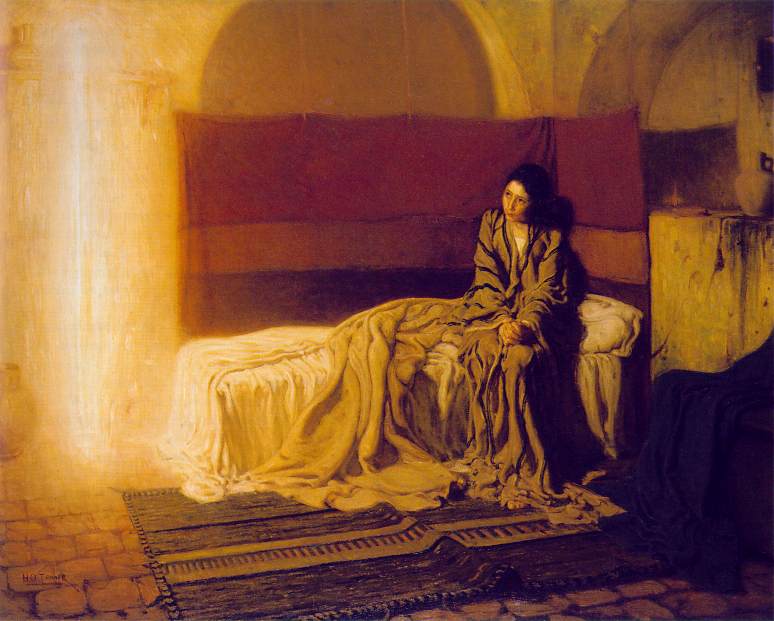
* The images in this post come from: " The Annunciation" by John Collier; "The Annunciation" by Henry Ossawa Tanner; "The Annunciation" by Dante Gabriel Rossetti; Sculpture by Karen Schmidt, "Mary and Elizabeth."

Finding Joy in the Chaos

Yesterday, I made the mistake of once again attempting the wilds of the Christmas Tree Shop. I know. I know. I should have known better. But I was honestly hopeful that it would not be that bad. It will be a quick stop. I’ll just run in and run out. Ten minutes top.

Right.

Between the throngs of shoppers, the endless lines, and the ransacked shelves it was far from the quick stop I imagined it would be. Add a tired, hungry baby with a dirty diaper and you have the recipe for disaster. After winding my way through the aisles, arms full of all I could carry (since there were no more carts to be had), scouring and scavenging the shelves for the last few boxes of lights, and standing in line for well and over 15 minutes, all the while listening to the inane, overly jolly Christmas music, I was about to lose it. And so when I walked out in the cold brisk winter wind to the sound of the Salvation Army guy wishing me a “Merry Christmas,” it was all I could do not to turn around and yell at the poor man. I was up to my limits of holly jolly frivolity and could feel myself about to snap. Merry Christmas, please!

Since Halloween we have been bombarded by the world’s shallow expressions of Christmas joy. Just turn on your TV. You can’t escape it. The constant loop of commercials advertising the happiness to be found in Gap sweaters, Folger’s coffee, or Kaye’s. The perennial parade of Christmas classics offering saccharine sweet stories of joy and hope. The images of happy families gathered around the Christmas tree arm in arm. TV this time of year is like the Hallmark channel on steroids.

And, yet, despite the onslaught of so-called joy, there remains the news ticker ever present scrolling across the screens of our lives with word of rising unemployment, increasing rates of poverty, escalating violence in the world, mounting costs of health care, intensifying harm done to environment, growing sense of dis-ease.

Despite the world’s celebrations going on all around us we know that just below the surface is a cauldron of fear, anxiety, and doubt. Our own lives are marked by these common fears and uncertainties…whether it is the anxious anticipation of having to spend the holidays feigning family bliss or the deep-seated fear of spending the days alone, whether it is the strain of buying gifts for everyone or the anxiety of not having enough to buy any gifts. Whether it is the pain of loved ones lost or the sting of friends estranged…the superficial holiday cheer seems only to heighten our own anxieties and leave feeling less than jolly this time of year.

It is in this chaotic and difficult context that we hear the dissonant words of Paul this evening. “Rejoice! Rejoice in God always, again I say rejoice.”

This is one of those texts that appears frequently in the lectionary in both Advent and Ordinary time, yet it is a text nonetheless that I have never, ever preached. The simplicity of joy always seemed too, well, overly optimistic given the state of our lives and the world around us. As you know, I prefer to preach a prophecy of woe…the world is rough, but God loves you. Too much sunshine, lollipops and puppy dogs can ruin a good Christian, right?

And yet, the words of Paul remain. Rejoice in God always, again I say rejoice.

In order to engage this text this week, I had to get over all of my negative connotations of this text engraved on sappy Christian tchotskys and emblazoned on evangelical bumper stickers. I had to let go of the cheesy camp songs, and blithe advice doled out late at night by creepy televangelists and let the text speak for itself. Despite popular renditions of this verse as a Christian version of “don’t worry, be happy,” Paul has something much deeper in mind than a simple “letting go and letting God.” The joy about which Paul speaks is not devoid of pain. How could it be?

Paul is writing this letter to the Philippians from jail. Arrested for preaching the gospel and endangering the State, Paul writes in a dingy, crowded, dirty jail cell from which he may leave only to head to the executioner’s block. This is a person who understands the reality of pain and suffering in the world.

William Loader reminds us that:

“joy is never alone. Its companions are pain and fear. ..Paul's sense of joy is not the absence of pain or fear, but the presence of Christ, in whom Paul places his hope and trust. That unity [both] takes him into pain and death, and…leads him over and over again on a journey from death to life, from pain to joy. Sometimes Paul’s joy stays alight as a flickering flame amid an oppressive darkness of criticism and downright hate. But it remains and can flare into brightness at relief and change.”
You see, joy for Paul is not a simple emotion, but rather a committed attitude or orientation toward life. It is a fundamental way of seeing things, a new perspective that radically changes one’s experience of the world. In this way, it is not a negation or avoidance of struggle, but rather the very way in and through the pain and fear of life. Joy is not a mask to cover up the less pleasant times of life, but rather the underlying foundation of hope without which one cannot encounter life’s pain and survive. This type of deep joy is what keeps us sane, what buoys us up, what helps us get out of bed in the morning and enables us to simply put our feet on the floor despite the chaos of our lives.

And where, do we find such joy, such hope? What brings about such a radical reorientation in our lives? What force can effect such a change?

Huston Smith, renowned religious scholar, asserts that “The only power that can effect transformations of [that] order… is love.” Likening it to the immeasurable power contained in an atom, Smith writes,
“The 20th century discover[ed] that locked within the atom is the energy of the sun itself. For this energy to be released, however, the atom must be bombarded from without. So too, locked in every human being is a store of love that partakes of the divine -- the imago dei, the image of God that is within us. And it too can be activated only through bombardment -- in its case, love’s bombardment.”

We know this as we see it happen in our own lives. Smith writes, “A loving human being is not produced by exhortations, rules and threats. Love takes root in children only when it comes to them.”

Watching children and their parents one gets a glimpse of the mutual way in which love arises. Parent and child, loved and loving, call forth the best in one another as they exchange glances, glimpses, caresses, nudges of tenderness, gentleness, kindness, and compassion. It is this love that brings forth the ground of joy that sees both parent and child through the inevitable rough times of life.

During those long nights of waking, during those unexpected crying jags where nothing will soothe him, it is the memory of the tender caresses and wide, sly smiles from Grady that sees me through. The gentle touch of his hand on my cheek, the warm embrace of his tiny arm wrapped tightly around my neck, the silly laughter echoing in my ear...all tie me back to the ground of love and my source of joy that sees me through the hard, long sleepless nights.

Think about your own experiences of love and the way in which they transformed your life…perhaps it was the glow of your first love that sent waves of ecstatic joy through you, that colored the world around you in ways that highlighted the joy and brilliance of the world in new and unimaginable ways. Or perhaps it is the memory of a loving parent, a compassionate friend, a kind stranger that for a moment transformed your world from hues of dull grey and shadows to brilliant rays of glorious light. It is the experience of being loved that elicits that deep, satisfying sense of joy.

And so it is also with God. It is the mutual love affair between human and divine which helps us access that joy of which Paul speaks. Whereas our human love, no matter how joyful or well-intended, always fails, God’s love never fails.

As wonderful as the love is that exists between me and Grady, I am all too well aware that one day, perhaps at age 13 or 15 or 17, the memory of those gentle touches and silly laughter may seem all too far away. And as much as I dread it, there will also come a day when despite my best efforts and intentions, the love I have for Grady will simply not be enough to satisfy his soul. Our human love, no matter how well intended, is always finite, limited and imperfect. And because of that there will come a time when both Grady and I will disappoint one another.
That is why we must connect to and remain grounded in the love of God. It is only that deep and abiding love that can evoke the joy to carry us through the pain and despair of life.

Imagine the power of connecting to that first, primal, unimaginable source of Love from the divine. How would our lives be transformed if we were certain that we were totally loved by the ultimate power in the universe? Huston Smith puts it this way,
“If we too felt loved -- not abstractly or in principle but vividly and personally -- by one who unites all power and all goodness, the experience could dissolve fear, guilt and self-concern dramatically. If, as Kierkegard noted, we were at every moment certain that nothing has happened or can ever happen that would separate us from the infinite love of the Infinite, that would be clearest reason there is for joy."

Paul understood that to remain in contact with such a real sense of God’s love, we needed to practice it among one another and so, the passage in Philippians ends with concrete instructions for cultivating that sense of love through community.

Finally, beloved, whatever is true, whatever is honorable, whatever is just, whatever is pure, whatever is pleasing, whatever is commendable, if there is any excellence and if there is anything worthy of praise, think about these things. Keep on doing the things that you have learned and received and heard and seen in me, and the God of peace will be with you.

The joy and peace of God come most fully through the practice and cultivation of love…through gentleness, mercy, honor, truth and compassion. William Loader reminds us, “Paul is not just advocating the power of positive thinking. These concrete instructions to the community of faith are about filling one's mind with what Paul sees as the signs of God's life - not so that will feel good, but because this is another way of filling oneself with God's life and so allowing God's life to flow through us to the world around us.”

Truth be told, I went to the Christmas Tree Shop yesterday in search for lights for a tree…which I vowed I wouldn’t put up this year…there was simply too much to do to be bothered by Christmas! Yet, standing outside the store waiting for Josh to pick me up, something happened. Despite my own stoicism or perhaps even cynicism, the bell ringer kept talking.

“It sure is cold out here today. You should button up your coat. You don’t want to get sick.”

And, in the midst of his chatter I turned to look at him a man, in his 40s, dressed in not more than a fall jacket and a thin knit cap, ringing his bell and being concerned about my warmth, my health, my well-being. I was struck by his sincerity. The more he talked, the more I realized this was no schtick to get me to donate, this was simply a conversation from one cold person to another.

Suddenly the anxiety and worry that had nagged me as I shopped seemed to disappear in the light of this small conversation. Worries of finances, moving, transition, change, time, work, all melted for the moment and I let go of that which was keeping me not just from joy, but from real human interaction. And so, when the car pulled up and he said goodbye, wishing me a Merry Christmas, I turned and smiled, “Merry Christmas to you to.”

Despite my best intentions to keep Christmas at a distance this year, something in his words sunk in.

In this Advent, we are called not to bah humbug the superficial joy of the world that seems to negate the reality of pain in the world, but rather to cultivate and share a deeper sense of joy, a joy that reorients our vision and springs forth from the well of love the Divine has for us. Once we cultivate that experience of love in ourselves, we become able to openly share it with one another and move past the saccharine sentimentality to a true sharing of the Christmas spirit, that love and peace that passes all understanding.

Wednesday, December 09, 2009

Making a Path to the Water's Edge

This parable recounted on the blog Telling Secrets, is by the South African activist, Olive Schreiner,and it is one of my very favorite sacred texts for it evokes the collective ongoing journey of humanity. Schreiner, like that lonely woman on the path, had once searched for a passageway out of the narrow confinement of Victorian life. Growing up as a child of Wesleyan missionaries, Schreiner questioned her family’s beliefs about the propriety of South African society. While she never abandoned the vision of peace and justice she heard promised in scripture, she forged a different path, making a way to the waters’ edge for activists, feminists and pacifists after her.

Schreiner offers us an alternative Advent vision of the path through the wilderness. Her path through the South African wilderness mirrors the long journey through deserts of the ancient near east. Isolated and remote these two divergent paths through the wilderness both lead to a fabled river that forms the boundary between the way the world is and the way the world ought to be. A path to the water’s edge…

For the ancient Israelites that journey led to the Jordan, that ancient boundary between the exilic wilderness and the dwelling place of the Divine. That river, first crossed by Joshua and the people centuries earlier, is the symbolic threshold leading to the promised land. For the exiles in Babylon to which Baruch writes, the Jordan symbolized a homecoming, the heralded arrival of a people long displaced, coming back once again to the home which God promised.

Imagine the joy that this vision must have evoked for the people of Israel, long displaced and cut off from their families.

“See your children gathered from west and east
at the word of the Holy One,
rejoicing that God has remembered them.
For they went out from you on foot,
led away by their enemies;
but God will bring them back to you”

An image of the lost found. Rejoice, O Israel, for God will bring your children back to you. Do not fret the journey, for God has already prepared the path.

"God has ordered that every high mountain and the everlasting hills be made low
and the valleys filled up, to make level ground,
so that Israel may walk safely in the glory of God.
The woods and every fragrant tree
have shaded Israel at God’s command.
For God will lead Israel with joy,
in the light of Divine glory,
with the mercy and righteousness that come from the Holy One."

To those living in exile across the wild desert of the middle east, the image of a safe, straight path meant everything. The Divine preparation of the path, the lowering of the mountains, the raising of the valleys was more than a symbolic gesture of the coming dream of God that would radically shift the socio-political landscape. For those living far off across the desert, this meant a safe and speedy return home across the river Jordan. The wilderness between Babylon and Jerusalem was treacherous. A straight path without the obstacles of mountains and valleys signaled a sure way home for the children of Israel, a path to the water’s edge.

It is no coincidence then that in this text from Luke, we find John also standing at the water’s edge. There at the Jordan, in that liminal space between wilderness wandering and the promised land, John invites people into the rushing, wild waters in preparation for the coming kin-dom.

John understands that there is still more work to do. For while, it is true that the Israelites have literally crossed into the promised land from their wilderness wanderings, the journey is not yet complete. In fact, the promised land once attained was not at all what they expected. Not only did it come at the cost of those who lived in the land before them…through warfare, death and destruction…but it turned out not to be the place of tranquility, peace and justice they imagined. Centuries of violence, conquest and oppression proved that. In fact, from the time they crossed to perhaps the present day, it seems the occupation of this land brought more conflict and chaos than peace and prosperity.

Mere occupation of the promised land did not usher forth God’s dream of peace and justice. For that, the people had more work to do. That is why John called the people to a baptism of repentance of sins. For John, this was not merely a verbal act by which sins are confessed. But rather it was, in Greek, a metanoia, In the words of Herman Waetjen, it was

“a turning around, a 180-degree change of direction, and therefore a change of mind. It is a movement into transformation that involves the total person. Repentance, as a termination of participation in the old moral order and an entry into a new moral order, inaugurates the active construction of a life and a way of living that corresponds to God’s [dream] for human beings. In time Jesus will instruct the disciples on the ethics of this new road into life. This is how to make the paths straight for the coming ‘kin-dom of God.’"


In fact, Jesus’ ministry will be consumed with instructing the disciples on how to forge that path in the world…through love, compassion, non-violence, forgiveness, and mercy.

While in the passage from Baruch, the people are promised a divinely made path, here in Luke, it is the people themselves who must forge their way not just to the water’s edge but in and through it in order to prepare themselves and the world for coming kin-dom of God. For still there exist barriers to the fulfillment of God’s promise. Even in the city of Jerusalem, in the city of the holy of holies, still there is something lacking for the completion of God’s promise. These barriers are ones both imposed from without and constructed from within. The people themselves have been kept from God by the powers and principalities of the world, and by themselves.

We recognize these barriers and obstacles to the Divine, don’t we? We who have oft been kept at bay by the institutional church know what it is like to have our path blocked. And at the same time, we confess we recognize the barriers and obstacles of our own making… towering mountains of hesitation, uncertainty, apathy; dark valleys of fear, anxiety, doubt; chilly, churning rivers of self-loathing, internalized oppression and despair. We, too, know what it is like to wander lost in the wilderness of life, don’t we?

John reciting the well known words from the prophet Isaiah, calls the people to join with God in the construction of a highway back to the Divine, by preparing a path for themselves and for their community that will lead them home to God, to the dream God has for them, to the fulfillment of the promise of shalom, God’s vision of peace and justice for the world. This is the message of John. Tear down the barriers, make the road plain, for kin-dom is surely coming and we must be prepared to be met by the Holy.

You see, the preparation for this journey toward the completion of God’s promise is a mutual endeavor between humanity and the Divine. Both are required to work together for the realization of the kin-dom.

Often in our liturgy at CWM, we talk of this as the co-creation of the kin-dom…something that cannot be done by God alone, nor by sheer human effort. Human and Divine need each other if this dream is to become reality. And, this my friends, is good news.

John’s call to us for transformation is at once individual and communal. We are called to turn our lives around, to begin a new on the path that leads toward God, while at the same time we are called to prepare the path for others. Like God who brings down the mountains and raises the valleys to cosmically break down the barriers for pilgrims on the path, we too are called to be preparers of the way. We participate with God in the preparation of the road that connects the wilderness and the world, that highway between our daily life and our encounters with the Holy.
Our Advent journeys are both about following and leading. Here at CWM, we have followed a path laid for us by members of our congregation who have since journeyed elsewhere. I am mindful of all those who have beaten the path to the water’s edge for us that we might be the queer church in Davis Square.

I remember David, co-founder, of CWM, who dreamed the dream and created space for the birth of a new type of church in the congregation he was serving. Without his vision and the hospitality of the people at Grace UMC in Cambridgeport, we would never have made it to the water’s edge. There on Magazine Street a dream was made reality and we took a step closer to who we are today.

I remember Tracy, a founding member of this congregation, who forged the path toward our communion table. Upon coming to worship the second Sunday in the month, Tracy, a former Roman Catholic was aghast to discover that we only served communion once a month. “But you can’t have church without the table? Do you think we could have it again next week?” Why not? And we took a step closer to who we are today.

I remember Joe and Craig, two other founding members of this congregation, who forged the path for our community meals. After a meager snack of store bought cookies and stale coffee, they suggested perhaps they could bring a light supper the next week. And what a meal it was complete with homemade apple turnovers and fresh pressed apple cider! And we took a step closer to who we are today.

I remember Dee Dee, our first intern, who suggested that perhaps the church become involved in local politics. She spent her first year making in roads into the greater Boston LGBT community for our congregation securing a feature in BayWindows, signing us as one of the first congregations to support marriage equality and creating name recognition for us throughout the community. Dee Dee initiated our commitment as a congregation to being active advocates for justice in the world. And we took a step closer to who we are today.

I remember Brian and Karen, Betty and Bill. I remember Jessica, Kirk, Terry, Jennifer, Susan, Jeff, and David. I remember Jen, Thi, Lucas, Jeremy and Chelsea. All of whom walked the path with us for a time.

These are just but a few of the faithful saints who have journeyed with us, helping to make a path to the water’s edge on which we now travel. While our paths have now diverged, their gifts remain with us as steps along the path, stones that built the bridge over which we now cross.
As many of you already know from our charge conference this past week, it has come time for paths to diverge again here at CWM. I have been invited to become the sixth Dean of Hendrick’s Chapel at Syracuse University beginning this March. My last Sunday with you will be February 14th. A new pastor will be appointed after the first of the year with whom you will travel further on the path. While we had anticipated that we might journey together a bit further to June, this invitation has sped our timeline up in unexpected ways…both for you as a congregation and for me as your pastor.

We have traveled this path together for nearly 8 years, forging the way forward together. It has been a mutual process in which together we made the path by walking. As I look back on our time together, I feel immensely blessed and privileged to have shared this journey with you for I myself have learned so much. Here I learned to be a pastor, here I found the meaning of community, here I discovered what it meant to truly be Church. As my faith home, you prepared the path for me. Thank you.

But now in the coming months our paths will diverge. The steps we have taken together, the path which we have tread, will remain. Only now God calls us forward to forge new ways of living and loving and being in different communities. While it is with real sadness and sorrow that we come to this unexpected turn in the road, we celebrate the path we have walked together and look forward in eager anticipation to the road that lay ahead.

Like that woman on the path, we, at CWM, find ourselves at the water’s edge, at the precipice of a new beginning. And, like John,we too exist in the liminal space of knowing the promise and yet not-yet living into its full realization. In this liminal, not-yet space, we are called to enter and cross over the river, to extend the highway, to forge ahead in new paths, navigating new territory so that we might wind our way closer to the Divine.

And while we confess that dwelling in this liminal space of already/not yet can be uncomfortable, raising our anxieties about our future, we have been called by God to make the way clear…not just for ourselves but for all those who will follow. Look around, the saints of CWM are not just those I have named. They are all around us. You are the ones who have made this path to the water’s edge…and now God is calling you forward into a new land, into a new space. God is calling all of us to enter the chilly waters that we might cross through to the other side and create new unimaginable paths that lead us and the world toward a greater realization of God’s kin-dom on earth.

Just as John has made the path to the water’s edge preparing the way for Jesus, so also, we too are called to prepare that path…and to extend it. The hope of Advent rests in us and in our courage to traverse the wilderness of our lives, making a path to and through the water’s edge for ourselves and for the world.

Monday, November 30, 2009

Preparing the Path to Advent

This weekend as I went Advent shopping for the church, I found myself once again confronted with the reality of the Christmas explosion. As I searched for purple Advent candles from store to store to store, I could feel my body tensing up with my usual Grinch-like disdain at the overly optimistic, sappy sentimentality of Christmas consumerism. The cloyingly jolly carols piped in even to the restrooms, the brightly colored baubles obscuring my line of sight, the hoards of eager after-Thanksgiving shoppers, the tacky, neon blow-up Nativity scenes, the shelves filled to brimming with cheesy Christmas tchotskies…all brought my blood to boil.

Why in the world cannot I not find a single purple candle in the sea of gold glitter, candy cane stripped, elf shaped, ornament ensconced candles stacked row upon row in the Christmas Tree Shop? Doesn’t the world know it is Advent, not Christmas? Hasn’t anyone read the lectionary for this week? There are no cute babies sleeping, no reindeer prancing, no Santa’s singing, no cookies baking!

You’ve read the lesson for today. You get it, right? In perhaps no other year of our lectionary cycle is the distinction between our secular Christmas expectation and our faithful Advent anticipation more vivid. Luke pulls no punches when describing the eschatological hope of the advent of the kin-dom. Far from the sentimental carols piped into to every grocery store, mall and post office is the stark vision of the end times we read in Luke.

'There will be signs in the sun and moon and stars; on earth nations in agony, bewildered by the clamour of the ocean and its waves; people dying of fear as they await what menaces the world, for the powers of heaven will be shaken.”

This is no baby Jesus meek and mild kind of holiday. This is serious people! This is about the end times, the apocalyptic vision of the days that are surely coming, says Jeremiah, when the Promised One will come…that Branch from David who will execute justice and righteousness, bringing salvation and safety to Israel and establishing a new order in which peace has priority and God’s dream is fulfilled. This is a 2012 epic-end-of-times saga that will not be pretty…agony, bewilderment, clamour, death…the very foundations of the world will be shaken.

A jarring contrast to the holiday madness of the world around us, no?

Our Advent lectionary helps point us toward the completion of God’s dream for the world, reorienting our gaze from the immediate gratification of overindulgent Christmas celebrations to the day in which peace and justice will come to be fully realized. These texts we read, both from Jeremiah and from Luke, arise out of a people who have long been beaten and battered by the world around, tossed to and fro between the world powers of Egypt, Assyria, Babylon and Rome. The eschatological and apocalyptic hope of which we read is rooted in the reality of a historically oppressed and marginalized people.

Both Jeremiah and Luke are speaking to communities who know their fair share of sorrow.
Jeremiah is writing during a time of prolonged exile and desperation. Kate Huey reminds us that

“this wasn't just a disaster in terms of the highest levels of government, when God's own people had been carried off to exile or were suffering its long-term effects. This was an everyday, lived experience of the ordinary person who felt their suffering as a judgment by God.”

It is to this situation of sorrow, grief and loss that Jeremiah proclaims the fulfillment of God’s promise.

Likewise, Luke writing just 15 years after the destruction of the temple of Jerusalem, addresses a community steeped in hopelessness and despair. His depiction of the fall of the temple is not prophetic prediction, but past history.

Both of these communities longed for something more, yearned for a day in which the promise they had heard repeated from generation to generation would be fulfilled…an end to oppression and injustice, an end to colonization and occupation, an end to poverty, marginalization and powerlessness, an end to sorrow, loss and grief.

We, too, can relate to these desires of a community long beleaguered by the powers and principalities of the world around them. Can’t we? We watch with horror at the injustices and sorrow in the world around us…the ravages of a war in Afghanistan and Iraq, the struggle of millions living with HIV AIDS, the suffering of those without clean water, nutritious food, or adequate shelter, the inequalities between those who have much and those who have so little, the brutal sting of prejudice and discrimination, the search for meaningful work and a just living wage, the grief of loved ones lost and promises broken. We, too, long for the promised coming of the kin-dom both in our world in and in our lives.

So in the midst of such significant eschatological and existential questions, it is understandable that we might get a more than a little annoyed at what seems like the nearsighted vision of a Christmas come in a Good Friday world. Why can’t the world get it right? This is not about some sentimental holly jolly season, but about the cold, hard reality of pain and suffering and our longing to relieve it. We know. We get it. Why can’t the rest of the world?

And yet, cruising the aisles of the Christmas Tree Shop, I found my eyes wandering to the piles of potential gifts for family and friends and began to feel my heart quicken and eyes glisten as I thought about the small joys some might feel at the gift of a plush blanket or wind-up toy. And then I began to get anxious about all I had to and wanted to do for Christmas…the cookies, the gift baskets, the holiday cards. ..not so much a nervous anxious, but an excited anticipation. I was actually looking forward to Christmas celebrations! In spite of my own best efforts to maintain my Scrooge like contempt at the Christmas frivolity, I found myself longing for a bit of the joy of the season.

Regardless of my own theological predisposition toward the kin-dom of peace and justice…I had to confront the idea that this is actually not a bad or even inappropriate thing to desire. You see the desire was not so much for the trappings of Christmas, but for that underlying yearning for moments, snatches, glimpses of hope in the midst of a chaotic, overly busy, rough and tumble world in which sorrow, grief and loss mark so many of the most of the days.

Advent is not an either/or endeavor. As we have been talking about these past few weeks in regard to the life of faith, Advent is a both/and event. It is both a time of expectant waiting for the fulfillment of God’s dream, and also the very present reality of that dream breaking forth in joyous celebration in the here and now.

The text from Luke helps us understand this both/and reality of Advent. Luke borrows from Mark this account of the end times, but adds something that alters the readers’ perspective.

“Be on guard so that your hearts are not weighed down with dissipation and drunkenness and the worries of this life, and that day catch you unexpectedly, like a trap . . . Be alert at all times, praying that you may have the strength.”

Luke’s addition to the Markan account points us toward the attitude or disposition with which we are called to face these times. Luke is concerned not just about our final destination, but also about how we get there. Both/And.

We live, according to Luke, between the two great poles of God's intervention in the world: the coming of Christ into the world as a tiny babe and the fulfillment of the kin-dom issuing forth peace and justice forever more.

Advent is this path between times…between the already and not yet, not only of Christmas, but of our lives. It is a liminal space in which we are called to prepare ourselves and the world for something more.

We know this in between space intimately, don’t we? Much of our own lives are lived in liminality. Kathryn Schifferdecker reminds us:

“There is a point, or a period of time, that we spend in between one time or place, and another time and place. In that in-between time, we have to live with things being not so clear or comfortable, not familiar and comfortable and yet not being what they will be one day. This "in-between time," though fraught with tension, is nevertheless also characterized by hope.”
It is in this in-between time that Luke calls us to pay attention. Be on guard! Wake up! Be Alert! For the path itself is a place of Divine revelation. It is the time not just of longing for what could be, but also for the celebration of what already is…the glimpses of God we see in our everyday lives…the joy, hope, peace and love we know in and through the world in which we live. While we long for the completion of the promise, for the fulfillment of our joy, we must take comfort in the moments and measures of grace which we see in our everyday lives…for those moments constitute the hope we need to carry on.

As liminal space, the Advent path must attend to both the destination and the journey itself. We are called to lift up our heads and keep our eyes on the prize that is to come… the days that are surely coming when a shoot will arise from the root of Jesse, the time in which the fig tree will come to fruition and the fulfillment of promise of God’s dream. But, we are also called to pay attention to the quotidian hope embedded in our everyday lives.

When we are able to simultaneously be present to the destination and the journey, we find ourselves strengthened for the road ahead. It is only in and through the hope of everyday joy that we find the strength to continue our collective journey toward God’s dream of peace and justice.…whether that be in the singing of a cherished hymn, the embrace of a friend, or even a tacky elf shaped candle for a family member.

These glimpses of hope in the midst of our wilderness lives are like that small, thin, fragile thread that we follow late at night through the dark forest journeys learning to grope and grasp our way through unchartered territory by trusting in the thin wire of hope that leads us through. Or perhaps, these glimpses of hope may even be said to be like breadcrumbs scattered along our path to lead us home once again. Nourishing and sustaining, yet never fully satisfying. We savor them and continue on yearning for more. That is the hope we get in Advent….already, and not yet all at once.

As we begin our Advent journey today, we heed the warning of Luke to be alert, keep awake, for the irruption of the kin-dom is imminent all along our pilgrim journey. It comes in glimpses and snatches, moments of grace and hope that lead us on. So, while no this does not mean we will start singing Christmas carols in worship (sorry), it does mean we will not simply wait for the fulfillment of God’s promise, but rather forge ahead following that thin, fragile wire of hope, gobbling up the breadcrumbs as they come, as we wind our way toward God’s dream in which we are overcome by the floodwaters of grace and hope, our very beings inundated by the presence of the Spirit.

Be alert! The kin-dom is coming here and now! So celebrate and be glad, for God’s hope is bursting forth in our midst!