Tuesday, April 27, 2010

[Easter 4C] Shepherding Community

[This is the text I preached off of -- though definitely not the verbatim text that actually came out of my mouth; for that, click the mp3 link at the bottom if you want. The Scriptures were all an adaptation of the NRSV and The Inclusive Bible -- with Annie playing Marty Haugen's "Shepherd Me, O God" for Psalm 23 -- and are at the bottom, just before the audiolink.]

Easter 4C - April 25, 2010
Acts 9:36-43
Psalm 23
Revelation 7:9-17
John 10:22-30
Shepherding Community

Will you pray with me?
Jesus, three times you said to Simon Peter, the rock on whom you built your Church: "Do you love me? Feed my sheep." May the words of my mouth and the meditations of all our hearts be filled with love for you and for each other, may they be food that will nourish and sustain us. Amen.
I promise not to rehash Sean's sermon from last week; I just love that particular bit of lectionary.

I'm not actually going to talk about sheep at all. When I first read today's lectionary, they seemed the obvious connecting thread -- except for the Acts passage -- and I think maybe my literature major self got stuck there. My friend Sophia, in contrast, after I'd told her about my lack of inspiration, read through the assigned lectionary texts and said: "I feel like there's something there, but it's sort of scattered and hard to get at beyond the obvious bent of the lectionary towards 'Jesus shows She is God by healing people, restoring them to community, and freeing them from fear and sorrow, and then bestowing on Her followers the ability to do the same.' "

I kinda just wanna leave it at that and sit down now 'cause that preaches all on its own, but that's a bit of a cheat. So let's dig into this idea a bit more.

Jesus restores people to community and empowers Her disciples to do the same. Okay, that's not exactly what Sophia said, but it's equally true.

At Lenten morning prayer this year at First Church Somerville, UCC, we read through most of the Gospel of Mark, and so when I read, "Tabitha, get up," in today's reading from the Book of Acts, my first thought was of Jesus saying, "Talitha, cum" -- "little girl, get up" (Mark 5:41).

That story is actually strikingly similar to the Acts story we read today. In Mark we read, in part:
They came to Jairus' house and Jesus noticed all the commotion, with people weeping and wailing unrestrainedly. Jesus went in and said to them, "Why do you make a commotion and weep? The child is not dead but sleeping." At this, they began to ridicule Jesus, and Jesus told everyone to leave. Jesus took the child's mother and father and those who had come with Jesus and put them outside and entered the room where the child lay. Taking her hand, Jesus said to her, "Talitha, koum!" which means, "Little girl, get up!" Immediately the girl, who was twelve years old, got up and began to walk about. At this they were overcome with amazement. Jesus strictly ordered them that no one should know this, and told them to give her something to eat. (Mark 5:38-43)
Both times, those who loved the deceased woman are weeping and mourning, and someone begs a healer to come, and having arrived, the healer sends everyone else away and invites the deceased to rise -- as if she had only been sleeping. The healing occurs one-on-one, in private. But after the person is restored to life, the rest of the community re-encounters her. Being restored to life means also being restored to community.

Tabitha, or Dorcas, is identified as a disciple, and my HarperCollins NRSV Study Bible says that this is the only time in the entire New Testament that the female word for "disciple" is used. That's kind of a big deal.

But restoration to community doesn't only happen to "good" people.

The Acts passage last week was the story of Saul's conversion. In persecuting those perceived to be heretics, Saul was serving God the best way Saul knew how. But God appears to Saul in a vision of the Risen Christ and says, "You're persecuting ME."

Christ doesn't just convert Saul on the spot, though. Christ incapacitates Saul and then sends the disciple Ananias to heal Saul.

Ananias, knowing Saul's history of persecuting followers of the Christ, says, "Are you kidding me? This person has authority to KILL us and you want me to not only bring myself before this person but also to bring this person back to full capacity?"

And Christ says to Ananias, "Go anyway. Saul is the instrument I have chosen to bring my Name to Gentiles, to rulers, and to the people of Israel" (The Inclusive Bible).

The resurrection of Tabitha comes in between the story of Saul -- who after his conversion will continue to declare his strong Jewish credentials in many of his letters -- and the story of Peter's vision of clean and unclean food -- the beginning of Peter's ministry to the Gentiles.

Joppa is one of the oldest port cities in the world -- now known as Jaffa, in Tel Aviv.

Port cities are liminal places, right?

Tabitha is singled out both in the Book of Acts and in the lectionary as someone whose discipleship is particularly remarkable. So in some ways we could see her as an "insider" in the early Christian movement.

But she's also identified with both an Aramaic and a Greek name. My friend Sophia wondered whether she was mixed-race, or mixed-identity in some other way. What liminal spaces does she occupy, living here on the edge of the land, known by two different names? Sophia suggested, "There are lots of ways for her to have trouble communicating her whole self to the people around her."

In my reflection the first week of Easter, I reminded us that resurrection changes things -- the risen Christ is not the same as the human Jesus who was crucified. Coming out is also a resurrection idea. We emerge from the oppressive darkness that has kept us from full life and we are transfigured, able to be transparent to the ground of our being, to shine with the light of divine love.

I don't think that any of us are empowered to literally bring people back from the dead, but we are empowered to help people communicate their whole selves to those around them.

In our Welcome here at Cambridge Welcoming Ministries, we often say: "You are welcome here not 'in spite of' who you are, but because of who you are." We invite you to bring your whole self, and hopefully the practice of doing that every week here strengthens us to do that out in the world the other six and a half days a week -- to be honest about our whole selves and to be open to the whole selves of other children of God, including the parts we maybe don't personally like so much in ourselves and in each other, to create a safe space where people can BE their whole selves.

A pastor recently commented to me that being present with people is the essence of pastoral care. Reflecting on that later, I thought about how being present with people in a truly genuine and loving way enables them to be their authentic selves, to live into the fullness of who God created them to be.

And so in these resurrection stories, the healer is genuinely attentively present with the other person, and is empowered to restore them to individual life and to community life, and I think implicitly to a life that is richer and fuller than the one they had before.

In today's Acts passage, we hear that because of Peter's action, many came to believe in Jesus Christ.

They didn't come to believe in Peter -- who was the one who actually showed up in the flesh and raised this woman from the dead. They came to believe in Jesus Christ. They saw the power that Peter had, the power to restore to abundant life, and they gave their hearts to the Source of that power and love. For "credo," which we translate "believe," doesn't mean an intellectual assent to a set of propositions but rather to give one's heart to.

The Mark story I recalled for us earlier contains one of many instances of Mark's Messianic Secret -- Jesus saying, "Don't tell anyone about this." There are a lot of possible explanations for Mark's Messianic Secret, and one of them is that Jesus wanted the focus to be on the good work that was being done, not on the particular human being who was doing it.

In some ways, I think today's John reading echoes the Messianic Secret. People keep hounding Jesus to proclaim, "I am the Messiah," and Jesus says, "You don't get it, do you? You seek declarations in words, but my deeds testify to who I am. It's not about the titles bestowed on me, but about what I do."

Throughout Eastertide we read excerpts from the Acts of the Apostles. Not the "statements of belief" of the apostles. Not the "codified doctrine" of the apostles. But the Acts of the apostles.

In the book Loving Jesus, Mark Allan Powell proposes that "The mission of the church is to love Jesus Christ; everything else is just strategy" (178). And last week's lectionary reminds us that we do this by feeding each other.

A commentary I once heard on the 23rd Psalm that really stuck with me was on the ambiguity of "You prepare a table before me in the presence of my enemies." That the intuitive interpretation is that you get to have a table prepared for you while your enemies look on, displeased at your good fortune, with an implication that your enemies are not partaking of this bounty -- because they're the defeated foe. But what if you were all at table TOGETHER?

This table here, this Communion table, is open to ALL.

That table over there, those tables we will bring out for dinner after our worship service is over, those tables are open to ALL.

There's a quotation I'm always attributing to Corrie ten Boom, but the Internet informs me that the correct attribution is Joanna Macy, a Ph.D. in comparative religion. The quotation is, "The heart that breaks open can contain the whole universe." Apparently the source is a meditation exercise she developed to help people respond to the world's pain. Describing an exercise called "Breathing Through," she writes, "If you experience an ache in the chest, a pressure within the rib case, that is all right. The heart that breaks open can contain the whole universe. Your heart is that large. Trust it. Keep breathing."

Have you ever had that feeling that you feel like your heart is so full -- be it with sorrow or with joy -- that it's going to break your very chest open?

I wonder if that's what God feels like all the time.

God so loved the world that God Incarnated to be with us more fully, and the Incarnate God suffered as humans suffered, even unto death, and conquered death so that we might all partake of the abundant life that God has always desired for us. This is the joyous mystery we celebrate every Easter, every Sunday, and every day. And part of this mystery is that we are empowered to continue Christ's work -- to conquer the forces of death and bring people, ourselves included, into life abundant.

Today's Revelation passage originally says, "washed in the blood of the Lamb," which I suspect you already knew. One of the things that this church, with its discomfort with blood atonement theology, has taught me is to swap out "love" for "blood" in, for example, hymns. You might be surprised at how little this changes the meaning. For God, in the incarnate person of Jesus the Christ and always, pours out abundant love for us.

And Divine Love is sufficient to make anything new -- to make clean and fresh that which has been stained by suffering and pain.

And there is a way in which divine love is poured out like blood shed, because God suffers with us. When we are wounded, God is wounded, too. This reminder both comforts us when we feel alone and also reminds us not to hurt others, for they are beloved children of God just as we are.

Carolyn reminded me that this is Earth Sunday. We are reminded in today's lectionary readings that God's kindom includes green pastures and still waters. God's kindom is a place where no one will suffer scorching heat but will be led to springs of the water life. God's kindom is a place where no one will hunger or thirst.

We're called to bring about that kindom here on Earth. We are called to prepare tables of abundant welcome. We are called to protect all inhabitants of the planet from heat that scorches and kills. And we are called to do all this in love.

And so I send you forth, assured in the love that God has for you, and challenged to share that love with all.

Amen.


Acts 9:36-43

36Now in Joppa there was a disciple whose name was Tabitha, which in Greek is Dorcas. She was devoted to good works and acts of charity. 37At that time she became ill and died. They washed her body and laid her in an upstairs room. 38Since Lydda was near Joppa, the disciples, who heard that Peter was there, sent two messengers to Peter with the request, “Please come to us without delay.” 39So Peter got up and went with them, and upon arriving was taken to the room upstairs. All the widows stood beside Peter, weeping and showing tunics and other clothing that Dorcas had made while she was with them. 40Peter put all of them outside, and then knelt down and prayed. Peter turned to the body and said, “Tabitha, get up.” Then she opened her eyes, and seeing Peter, she sat up. 41Peter gave her a hand and helped her up. Then calling in all the saints -- including the widows -- Peter showed her to be alive. 42This became known throughout Joppa, and many believed in Jesus Christ. 43Meanwhile, Peter stayed in Joppa for some time with a certain Simon, a tanner.

Revelation 7:9-17

9After this I looked, and there was a great multitude beyond number, from every nation, from all tribes and peoples and languages, standing before the throne and before the Lamb, robed in white, with palm branches in their hands. 10They cried out in a loud voice, saying, “Salvation belongs to our God, who is seated on the throne, and to the Lamb!” 11And all the angels stood around the throne and around the elders and the four living creatures, and they fell on their faces before the throne and worshiped God, 12singing, “Amen! Blessing and glory and wisdom and thanksgiving and honor and power and might be to our God forever and ever! Amen.”

13Then one of the elders addressed me, saying, “Who are these, robed in white, and where have they come from?”

14I said to the elder, “You are the one that knows.”

Then the elder said to me, “These are the ones who have come out of the great ordeal; they have washed their robes and made them white in the love of the Lamb. 15For this reason they are before the throne of God, and worship day and night within the temple, and the One who is seated on the throne will shelter them. 16They will hunger no more, and thirst no more; the sun will not strike them, nor any scorching heat; 17for the Lamb at the center of the throne will be their shepherd, and will guide them to springs of the water of life, and God will wipe away every tear from their eyes.”

John 10:22-30

22At that time the festival of the Dedication took place in Jerusalem. It was winter, 23and Jesus was walking in the Temple area, in the portico of Solomon. 24The Temple authorities gathered around Jesus and said, “How long will you keep us in suspense? If you are the Messiah, tell us plainly.”

25Jesus answered, “I have told you, and you do not believe. The works that I do in my Parent’s name testify to me; 26but you do not believe, because you do not belong to my sheep. 27My sheep hear my voice. I know them, and they follow me. 28I give them eternal life, and they will never perish. No one will snatch them out of my hand. 29What my Parent has given me is greater than all else, and no one can snatch it out of the Parent’s hand. 30The Parent and I are one.”


audiofile (21.4MB, 15:34min)

Sunday, January 10, 2010

Baptism of Jesus (C) - January 10, 2010

Baptism of Jesus (C) - January 10, 2010

Isaiah 43:1-7
Psalm 29
Acts 8:14-17
Luke 3:15-17, 21-22
Will you pray with me?

Creating, Sustaining, Redeeming God, I invite your Holy Spirit to move in this place, that the words of my mouth and the meditations of all our hearts may bring us into your Light, O God.

Amen.
The day after Thanksgiving, just a few days after I'd agreed to preach this Sunday, I was at a dinner party, and one Jewish woman asked, "Why did Jesus need to get baptized?  Wasn't he, like, The Man?"

"Therein lies a tale," said one of the other Christians in the room.

Which tale we are told in the Gospel of Matthew:
13Then Jesus came from Galilee to the Jordan to be baptized by John.  14But John tried to deter Jesus, saying, "I need to be baptized by you, and do you come to me?"

15Jesus replied, "Let it be so now; it is proper for us to do this to fulfill all righteousness."  Then John consented.  (Matthew 3:13-15)
Okay, so it still doesn't really answer the question.

My NRSV says, "Righteousness, right conduct in accord with God's will as revealed in scripture."

So I still don't know why Jesus was supposed to be baptized.

John Howard Yoder says: Before Paul and the new humanity, even before Jesus, baptism also meant repentance and cleansing.  It meant "You can leave your past behind." (Body Politics, page 41)

This is a useful formulation for me -- the idea of baptism as marking a new start.

In their book The First Christmas, Marcus Borg and John Dominic Crossan posit that it is not that some of the Gospels are missing some of the years of Jesus' early life but that "all the years are missing until the story of Jesus begins---as it does in all four gospels---with John's baptism of Jesus" (40).  They posit the birth narratives in Matthew and Luke as overtures to the story of Jesus' adult life and ministry, as parables rather than historical accounts.  I'm not going to get into a discussion of the birth narratives here, I merely mention it to provide the appropriate context for that line that so strikes me -- "the story of Jesus begins---as it does in all four gospels---with John's baptism of Jesus."

The birth narratives have marked Jesus as special in various ways, but here Jesus is publicly marked out.

“You are my Child, the Beloved; with you I am well pleased.”

You know this baptismal liturgy from the many times Tiffany has told this story -- "You are a bright, brilliant, beloved Child of God.  And you are beautiful to behold."

Jesus is named and claimed by God, undeservedly.  This is a moment of grace -- not something we earn.

God says to Jesus, "with you I am well pleased," but there's no indication that Jesus has done anything particularly to merit this.  Luke tells the story of young Jesus in the Temple, but other than that Jesus hasn't done anything to earn this distinction.

Something I read recently commented on the fact that Jesus is marked as Chosen before the temptation in the wilderness.  While we might expect someone to not be publicly named as Chosen until after a period of testing, God makes a commitment here -- at the beginning of the story in some of the Gospels, certainly at the beginning of Jesus' adult life as recorded in the Gospels.

The Isaiah passage we read echoes this -- God says, "I have redeemed you; I have called you by name, you are mine.  When you pass through the waters, I will be with you; and through the rivers, they shall not overwhelm you; when you walk through fire you shall not be burned, and the flame shall not consume you" (Isaiah 43:1-2).  The hearer is named as redeemed, with no indication of merit or even a reason.

This reading opens Chapter 43 of Isaiah.  The preceding chapter, Chapter 42, closes with, "Who gave up Jacob to the spoiler, and Israel to the robbers?  Was it not God, against whom we have sinned, in whose ways they would not walk, and whose law they would not obey?  So God poured upon them the heat of God's anger and the fury of war; it set them on fire all around, but they did not understand; it burned them, but they did not take it to heart."

The people Israel have turned against God, and God has punished them, and they still haven't gotten the message.

"But now thus says the Lord, who created you, O Jacob, who formed you, O Israel: Do not fear."

We remember that exhortation "Do not fear" from the Christmas story, right?  "Do not be afraid.  For I bring you good tidings of great joy that shall be for all the people.  Unto you is born this day in the city of David a savior."

"Do not be afraid, Mary, for you have found favor with God.  And now, you will conceive and bear a child, whom you will name Jesus.  This child will be great and will be called the Child of the Most High."

"Do not be afraid, Zechariah, for your prayer has been heard.  Your wife Elizabeth will bear a child and you will name the child John.  You will have joy and gladness, and many will rejoice at this birth."

When God speaks to you, it usually means your life is going to get turned upside down -- so opening with "Do not be afraid" makes a lot of sense (though Mary at least got a "Hello").

No one cautions Jesus not to be afraid.

I think because Jesus chose this.  Divine messengers and messages are usually reported as coming to people who aren't particularly seeking them, but Jesus is stepping into this baptism with full knowledge of the sort of path that lies ahead.

This is Jesus' coming out.

John has been proclaiming and enacting a baptism of repentance -- calling people to return to God, to begin a new chapter in their lives, preparing the way for the coming of One who will begin a new chapter in the life of the world.  So when Jesus shows up and asks to be baptized, John says, "What do you have to repent of?  You are the Holy One, the Child of God.  You should be baptizing me, so that I may follow you."

But Jesus recognizes the necessity of this baptism.  We don't know what stories Mary and Joseph told their firstborn about the angels, the shepherds, the magi, Simeon and Anna at Jesus' presentation at the Temple -- even what stories were told about Mary's visit to pregnant Elizabeth, or any of the other stories Jesus and John might have grown up hearing about themselves and each other.  But in whatever way, Jesus has spent three decades preparing for this moment.

In Acts we read that Peter and John went to Samaria and prayed for the people there that they might receive the Holy Spirit "for as yet the Spirit had not come upon any of them; they had only been baptized in the name of Jesus."  I've come to be a big proponent of believer's baptism (rather than infant baptism), but at the same time I'm not fond of the privileging of the moment of personal conversion (accepting Jesus Christ as your personal Lord and Savior), so I really like this idea that yes, these people had accepted the word of God, had been baptized in the name of Jesus, but their journey was not complete -- God was still working on them.

Whatever commitment we make before God and others, it is not the end of the journey.

John even tells those gathered at the Jordan: "I baptize you with water; but one who is more powerful than I is coming [...] who will baptize you with the Holy Spirit and fire."

Our baptism in water is an outward marker of our commitment to begin a new chapter in our lives, but it is our baptism with the Holy Spirit that sustains us throughout that journey.

After Jesus is baptized, "the Holy Spirit descended upon Jesus in bodily form like a dove."  I have this image of a six-foot-tall dove descending and enveloping Jesus is an embrace.

And indeed, we are beloved both spiritually and physically.

The Incarnation reminds us that we most fully encounter God in humanity, and the physical act of baptism reminds us that we are an embodied people.

So I invite you, as you move throughout this week, to remember your belovedness, to be attentive to the movements of the Holy Spirit, and to to live each moment as if you are a new creation in Christ -- because you are.

Amen.

Wednesday, December 23, 2009

Imagining Mary


Life is not always what you expect. Sometimes the most extraordinary of things happens in the midst of life’s ordinary moments. One minute you know exactly what’s supposed to happen and the next, well, the next you find the entire world seems to have turned upside down. At least that’s how it has been for me these past few months.

I was engaged to be married a year ago on my thirteenth birthday. It came as no surprise. I knew what was expected. Don’t we all know what is expected of us, after all?

I had watched one by one as my sisters were married off, sent to live with the new families. I watched as they each grew round with new life and gave birth, time and again. I visited them in their homes, brought news of mother and father and offered them a moment of rest by tending to their children or preparing the meal. I always loved visiting them, but things were different between us. The games of childhood were replaced for the daily tasks of life. Maintaining a household was not easy. Often as I sat in the homes of my sisters, I wondered which was harder, raising the children or taking care of the husband! Both seemed impossible! Mother laughed when I told her this, shaking her head she said, “Oh Mary, just wait till you get married.”

I knew the day would come, but I wished it hadn’t come so quickly. I wasn’t ready to leave my family…not yet and I surely wasn’t ready to care for a husband or a brood of children. I didn’t even know Joseph and yet in a year or two after the betrothal time was complete I was supposed to simply leave with him?

It didn’t seem fair. Not fair at all. How come he got to choose who he wanted to marry but I didn’t? How come he got to come and go as he pleased but I had to stay in the house? How come I was the one who had to be responsible for everything…for the house, for the children he expected me to bear, even for him? I knew this was what was expected. I had watched as my sisters married, leaving their childhood for the life of an adult, but I tell you, I was not ready for such a life. Not yet. I felt overwhelmed and utterly powerless. No one needed my consent. They just married me off whether I liked it or. But then again, what more could I expect? This was my place in the world.

I always secretly hoped there was more in life for me than just getting married. I wanted to travel, to see different places, visit new people. I wanted to learn more, do more, see more. When I was young I followed our rabbis around the village, following their shadows, listening to their every word. Before I knew better I told my mother I wanted to be a rabbi too. I wanted to learn to read the scrolls and tell the stories. I wanted to go inside the temple and pray for the people. My mother laughed and said that work was not for me. I was a girl.

But then again, what more could I expect? I am a girl after all…soon to be a woman, I suppose. This is the way life is. What more is there for me in life than to marry, bear children and be a faithful, obedient wife? I just needed to resign myself to my place in the world.

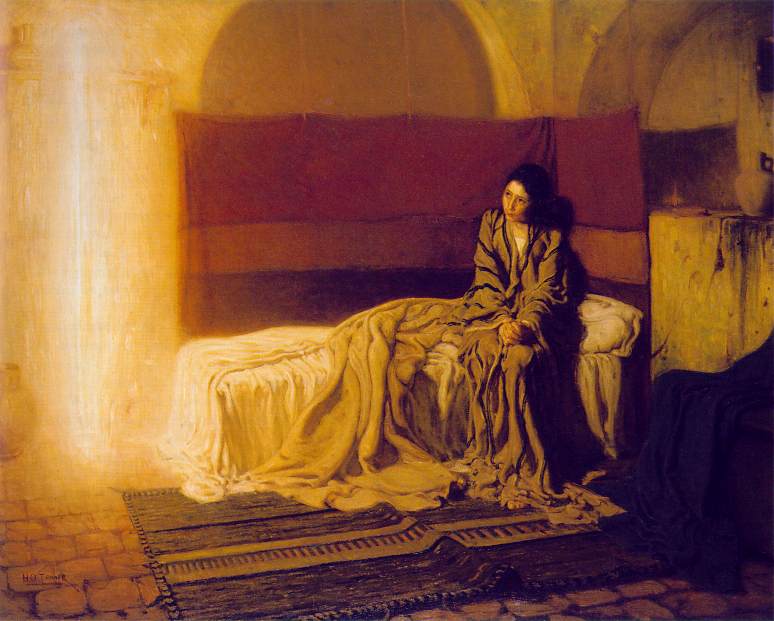
Shortly after my betrothal I was sewing in the courtyard. The day was nearly ended and I was hurrying to finish before evening fell and light left the landscape. Suddenly, there appeared before me a vision of light, dazzling and shimmering, like nothing I had ever seen before. The sun was setting but this light was brilliant. From the center of the light a form appeared. I pinched myself several times to make sure I was awake, truly awake. I looked around for others to confirm what I was seeing, but my family was no where to be found.

Fear swept over me. What was this? Who was this? Before I could move or cry out, a voice sounded from the figure of light. “Greetings, favored one! God is with you!”

I stared still unable to move. Favored one? Who were they speaking to? My father and brothers were still out working. Surely, this figure could not be speaking to me? A child? A girl? What did this figure have to do with me?

Before I could respond, the pillar of light spoke again. The voice was calm and soothing. Like my grandmother’s voice, it comforted me.

“Do not be afraid, Mary, for you have found favor with God.”

What had I done? I could not recall. I tried desperately to remember anything I might have done to please God…but all I could think of were my recent complaints and doubts and fears about getting married. What had I possibly done to find favor with God?

Again, the voice spoke, “And now you will conceive in your womb and bear a child and you will call him Jesus. Your child will be great and will be called the Child of the Most High and God will raise the infant to the throne of David to reign over the house of Israel for ever and ever.”

Without thinking I spoke back. Impudent perhaps, but I could not control myself. This didn’t make sense. Messenger of light or not, this seemed completely impossible.

“How can this be? I am still a child, betrothed but not yet married. I can’t yet have a child.”

I don’t know what possessed me but here I was talking back to what appeared to be a divine messenger from God. Looking back I can’t believe I was that bold. But it just didn’t make sense. This was not what I expected.

“The Holy Spirit will come upon you and the power of the most high will overshadow you; therefore the child to be born will be holy and will be the Child of God. Look, now your relative Elizabeth in her old age has also conceived a child and this is the sixth month for her who was said to be barren. Mary, nothing, nothing is impossible with God.”

I sat there stunned. I didn’t understand. None of this was to be expected.

Old Elizabeth? Pregnant? How could that be? Me? Bear the Child of God?

I sat there staring at the light. None of this made sense. Not at all. I didn’t understand. I couldn’t understand. But what could I say? My mind was racing trying to figure it all out, trying to make sense of the impossible.

And then, suddenly, my mind quieted. Peace passed into me beyond my wildest imagination and something from within told me to say yes. I don’t know why I imagined God needed my permission, after all God was God. But something told me, the decision was up to me. Before now nothing had been up to me. I had no power as a child, a girl, and now even as a betrothed woman. I had no power in the world, but here in this courtyard, in this moment, something told me to expect the unexpected. Something from within prompted me to say yes, for without my permission, without my consent, this holy divine plan could go no further.

And then, I heard myself calmly proclaim, “Here am I, the servant of God; let it be with me according to your word.”

It was as if the voices of the prophets and ancestors of old that I had heard proclaimed so many times before rose up from within and answered.

And then, as suddenly as the figure of light appeared, it disappeared and I found myself alone once again in the courtyard of my family home.

What was I supposed to do now? The angel had told me what was going to happen, but not how? I knew it was true. I felt it was true. But how was I going to break the news to my family? Or to Joseph for that matter? It was up to me to figure out what I had to do. A story of a divine visitation was not an easy one to believe…especially from a young, poor girl as myself. What would people think of me growing fat with child before the end of my betrothal? No one would believe me.

Suddenly the assurance I felt in the presence of the angel disappeared and fear rose up inside of me again. This was not the way things were supposed to happen. I knew what happened to women who had children out of wedlock. This was serious. Joseph would surely leave me. He could never bear the scandal. And my family? My God, what would my father say? I would probably be kicked out of my house too? What would become of me? A single mother is never welcomed…not anywhere. Suddenly horrible images sprang up in my mind. I would have to beg or worse…Panic began to set in.

This was not the way things were supposed to go. Not at all. No one would believe. No one…except perhaps, Elizabeth. The angel said she too was miraculously pregnant. Perhaps she could help me.

Without explanation I ran and found my father in the fields. I begged him to let me go and visit our relative Elizabeth. “There is no need for me at home. Joseph will not come for me for some time. And news is, father, news is that Elizabeth is pregnant. Let me go to her.”

And miraculously he gave me permission.

I set out at dawn the next day, anxious to reach her, sure she would have an explanation. Part of me hoped that I would arrive and find that she was not pregnant, that this was all a figment of my imagination. If she was not pregnant, then perhaps I too was not pregnant.

I walked all day through the Judean countryside. My mind still raced, trying to make sense of what was happening. This was not how things were expected to go. There was no way I could be the bearer of God’s child. Me? A poor, peasant girl? Divine things were left for powerful men…for Moses, adopted son of the Pharaoh, for David and Saul and Solomon, Kings of Israel and for the One to come, the savior, the messiah. People have been talking now of One who is to come and bring liberation for us. This One will break the oppressive rule of the Romans and free our people once again. With fire and might, with violent rage and terrible recompense he will save. This is the bearer of the divine, not me, a small, weak, powerless young girl.

As I walked the words and stories I had heard for so many years began to come back to me. This time it was not just the stories of the men of God, but of the women I had forgotten. I remembered the song of Miriam…and the song of Hannah…I remembered Sarah’s miraculous pregnancy and Hagar’s courage in the desert. God called to these women and they sang God’s praises. God lifted up ordinary people, women even, and led them to do extraordinary things.

As I pondered all these things in my heart I suddenly saw the world in a new way. Come to think of it, God never has done what the world expected. In fact, throughout the ages God has surprised the people by turning the world upside down. When the world wars violently nation against nation, God proclaims peace. When the world oppresses the outcasts, God proclaims liberation. When the world shuns those at the margins, God proclaims welcome for all. When the world starves the poor, God fills them with abundance.

The world’s expectations are not God’s expectations. The vision God has given us throughout the ages has always been counter-cultural. God’s vision of the way the world ought to be defies our human expectations. Peace. Justice. Acceptance. Inclusion. Abundance. These are not what the world expects.

The more I pondered these things, the more certain I was that God had called me to this task because I could do it. Like Miriam, and Hannah, like Sarah and Hagar before me, I had been called from my ordinary life to do something extraordinary. God chose me to defy the world’s expectations and do a new thing.

When I arrived at Elizabeth’s house, I could feel myself almost bursting with assurance, filled with great joy that God would choose me to do something so extraordinary. As Elizabeth welcomed me, she suddenly grabbed at her swollen belly. As the child lept in her womb she hailed me with an extraordinary greeting…

“Blessed are you among women and blessed is the fruit of your womb.”

Suddenly all that I had been thinking on my way here was confirmed and the joy that had been building could no longer be contained. Like Miriam and Hannah before me, I broke into a song of praise for my God.

“My soul magnifies God and my Spirit rejoices in my Savior, for God has looked with favor on the lowliness of me, God’s servant…” I found myself singing all the wondrous acts of our God that defy the world’s expectations… “Our God has brought down the powerful from their thrones and lifted up the lowly; Our God has filled the hungry with good things and sent the rich away empty. Our God has helped Israel according to the promise made to our ancestors to Abraham and to Sarah and their descendents forever and ever.”

The world’s expectations do not have to define or control us, for God has shown us more. What more can we expect? So much more.

God takes the poor, the powerless the oppressed and raises them up. Hasn’t this always been the message of our faith? Sometimes we forget under the weight of life’s expectations, but the message is still there waiting to be discovered and re-discovered over the ages. God has done wonderful things and continues to in every age. What more can we expect? So much more. For God promises a time when peace will usher forth, justice roll down like waters, and love will reign supreme.

The way things are, the way things are expected to be, doesn’t have to be. God has given us an alternative vision for the world, one that we can make happen if we just believe, if we just say yes, if we just give ourselves to the divine way of peace and justice. God can’t do it without us. We must say yes. We must concede. We must be the bearers of the Divine in the world. Not just me, but all of us. For each of us has a part to play in the unexpected good news of a God who turns the world’s expectations upside down. After all, all things are possible with our God.

And so, now these many months later, I am returning home. Joseph sent word that we are to travel to Bethlehem this week for the state census. This is not what I expected, to travel these last months of my pregnancy. But then again, what has been expected in my life lately? What more can I expect? So much more.

* The images in this post come from: " The Annunciation" by John Collier; "The Annunciation" by Henry Ossawa Tanner; "The Annunciation" by Dante Gabriel Rossetti; Sculpture by Karen Schmidt, "Mary and Elizabeth."